TODAY'S HIGHLIGHTS & WHAT TO KNOW THIS WEEK
- What does the Government reopening mean to communities around the DOE sites (once it happens)?
- CNBC Reports highlights that nuclear waste disposal solution is needed for new nuclear power projects in a story
titled - New U.S. nuclear power boom begins with old, still-unsolved problem: What to do with radioactive waste.
- ECA joined University of Michigan's Department of Nuclear Engineering & Radiological Sciences to discuss what the next generation of nuclear leaders can accomplish - read more below.
- Thank you to everyone who joined ECA's webinar on emergency response planning for nuclear projects. Click here to watch the recording!
- Join ECA to learn more about Advancing New Nuclear with Datacenter Development coming soon!
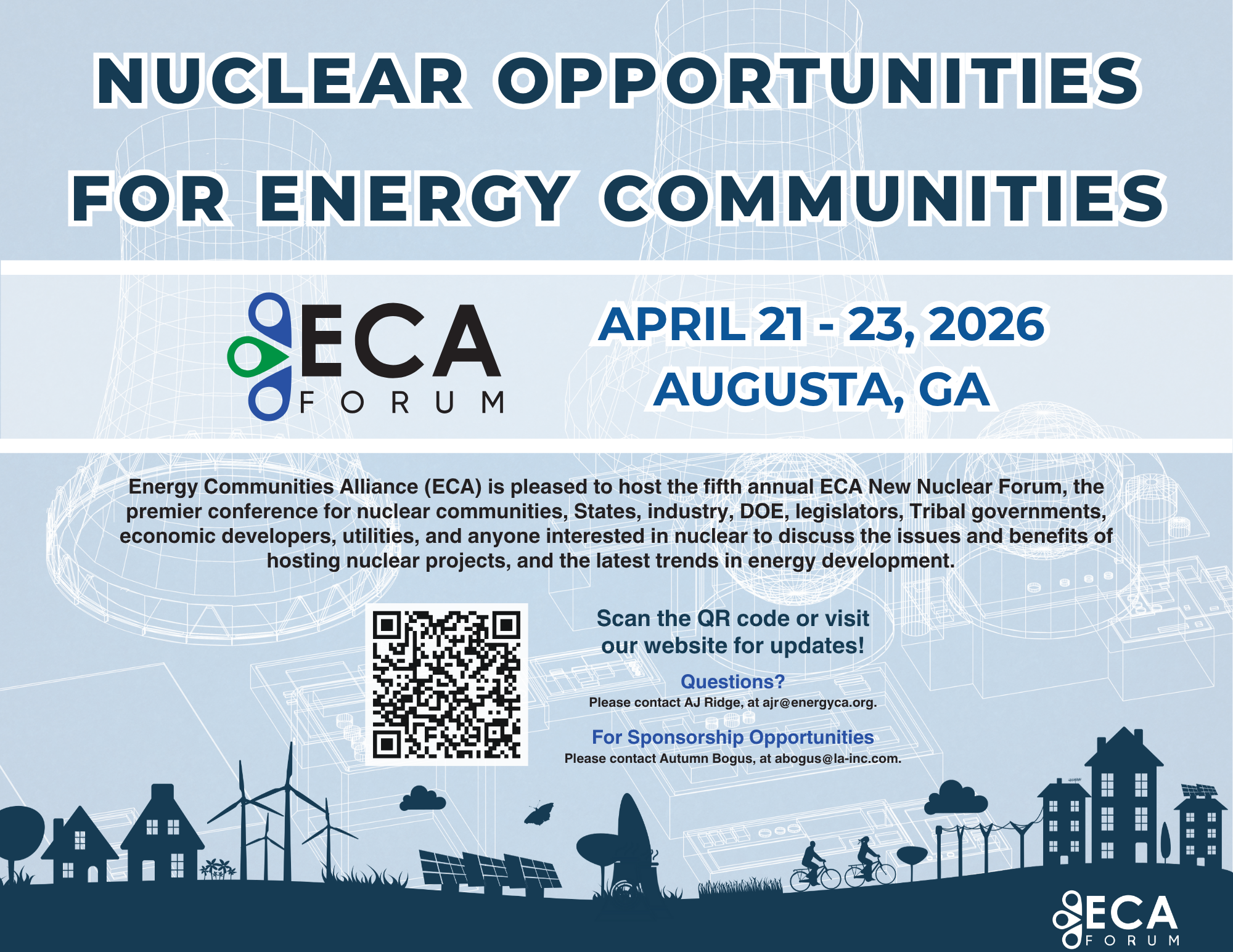
- ECA New Nuclear Forum to be hosted in Augusta, GA from April 21-23, 2026.
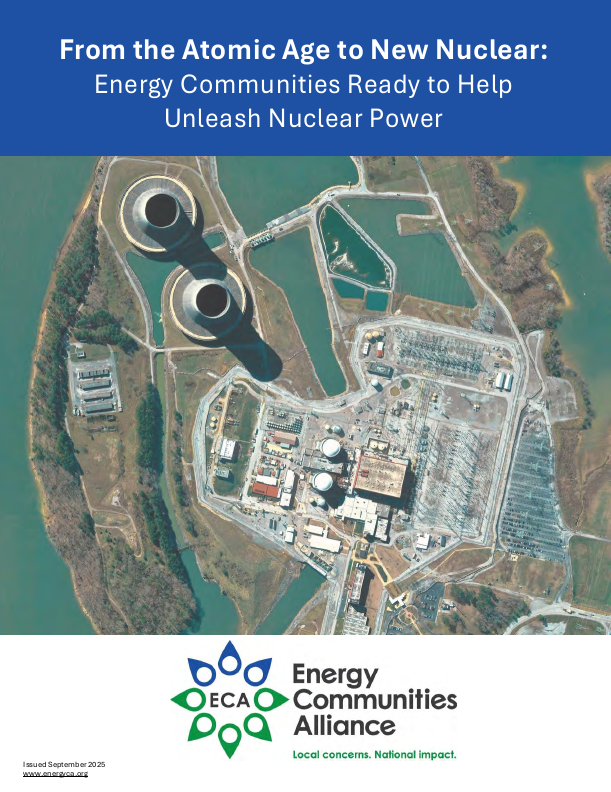
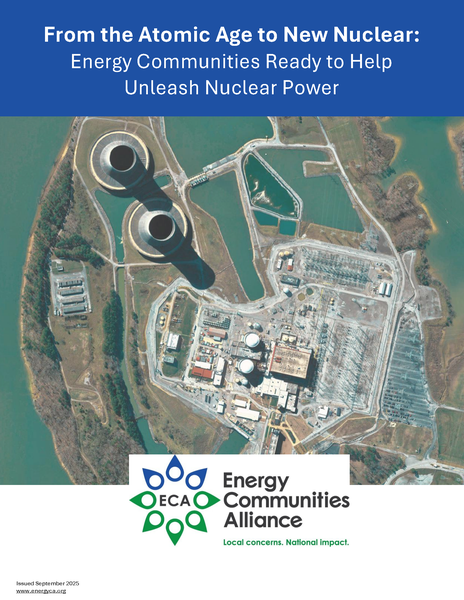
- ECA's latest report "From the Atomic Age to New Nuclear" highlights new nuclear projects across the country - see more below.
- Visit ECA on LinkedIn for regular updates.
WHAT DOES REOPENING MEAN FOR DOE COMMUNITIES (ONCE IT HAPPENS)?After 41 days, the Senate passed a government funding package Monday night after finding the 60 votes needed. The bill still needs to pass the House and be signed by the President before the government can reopen. The package includes a three-bill “minibus” that would fund the Department of Agriculture and the FDA, the Department of Veterans Affairs and military construction projects, and the operations of Congress for all of the current
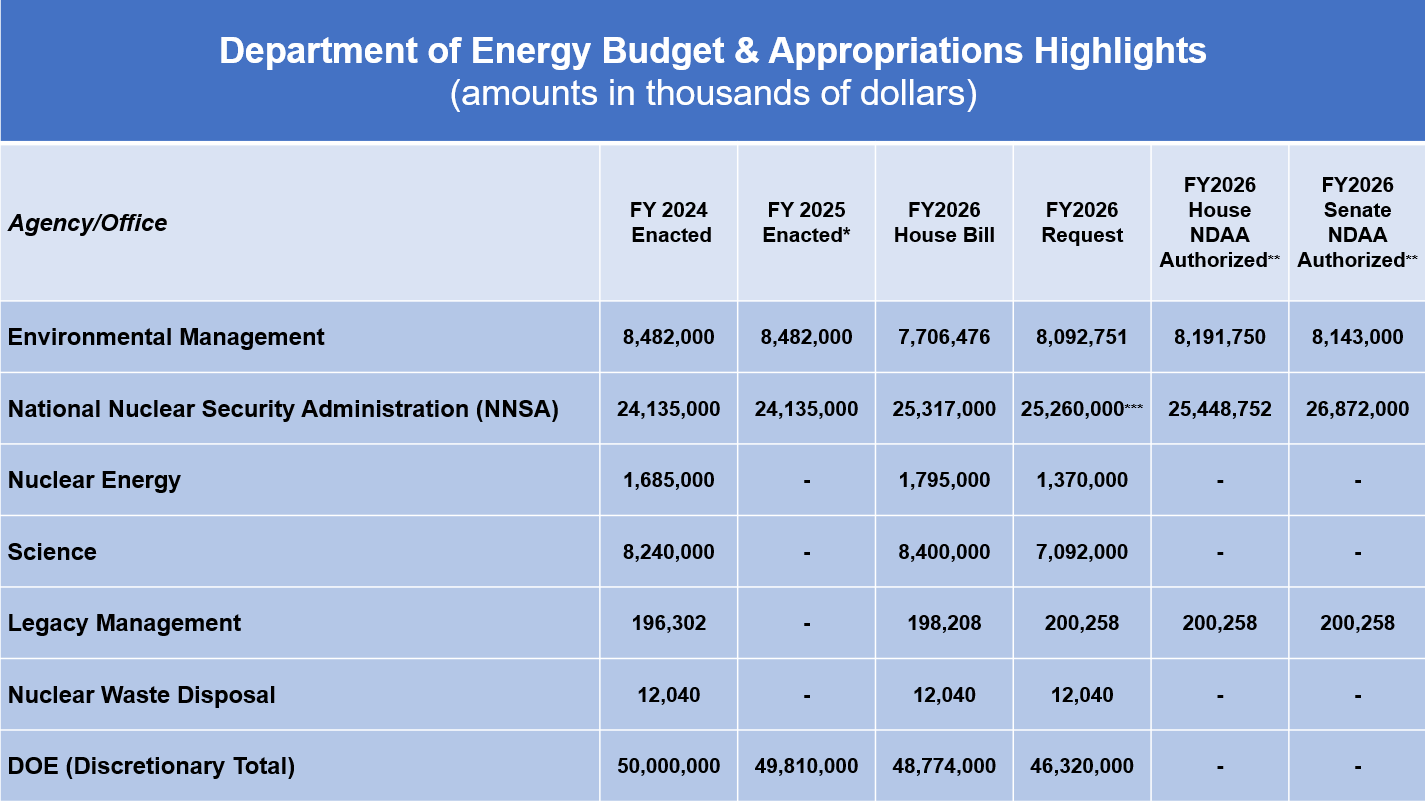
fiscal year — the product of months of bipartisan, bicameral negotiations between top appropriators. All other agencies, including DOE/NNSA, would be funded through Jan. 30 (so a federal government funding lapse could happen again). Since October 1, DOE sites across the country have experienced reported furloughs and layoffs for both DOE and NNSA. Many ECA members reporting the
impacts to small business contractors who have lost contracts working at the DOE sites. The continuing resolution (CR) passed by the Senate includes provisions for backpay for federal employees, however there are no provisions to include government contractors. Historically, contractors are not guaranteed backpay during a government shutdown, but until the final language is enacted, it is unclear at this time whether
contractors will receive backpay for the time the government was shut down. The impacts of the federal government shutdown have been very difficult for local communities around the DOE sites.
FROM CNBC - NEW U.S. NUCLEAR POWER BOOM BEGINS WITH OLD, STILL-UNRESOLVED PROBLEM: WHAT TO DO WITH RADIOACTIVE WASTEThe White House aims to quadruple the current nuclear energy output over the next 25 years through construction of conventional reactors and next-gen small modular reactors, but a clear solution has yet to emerge for the old issue
of radioactive waste, CNBC reports. More than 95,000 metric tons of spent nuclear fuel (with a minority from weapons programs) sits temporarily stockpiled in special water-filled pools or dry casks at 79 sites in 39 states. Currently, the Department of Energy has no permanent disposal facility for nuclear waste, leaving taxpayers on the hook for payments to utilities of up to $800 million every year in damages, a bill that
has reached $11.1 billion since 1998, and could grow to $44.5 billion in the future. Nuclear power is back, largely due to the skyrocketing demand for electricity, including big tech’s hundreds of artificial intelligence data centers across the country and the reshoring of manufacturing. But it returns with an old and still-unsolved problem: storing all of the radioactive waste created as a byproduct of nuclear power
generation. In May, four executive orders were issued which aimed at quadrupling the current nuclear output over the next 25 years by accelerating construction of both large conventional reactors and next-gen small modular reactors. Last week, the U.S. signed a deal with Westinghouse owners Cameco and Brookfield Asset Management to spend $80 billion to build nuclear plants across the country that could result in
Westinghouse attempting to spinoff and IPO a stand-alone nuclear power company with the federal government as a shareholder. There’s a growing consensus among governments, businesses and the public that the time is right for a nuclear power renaissance, and even if the ambitious build-out could take a decade or more and cost hundreds of billion of dollars, it will be an eventual boon to legacy and start-up nuclear energy
companies, the AI wing of the tech industry and investors banking on their success. But there are plenty of reasons to be skeptical. Only two nuclear power plants have been built since 1990, and they went online in just the last two years. Almost all of the 94 reactors currently operating in 28 states, generating about 20% of the nation’s electricity, were built between 1967 and 1990. And though often unspoken, there’s the
prickly issue that’s been grappled with ever since the first nuclear energy wave during the 1960s and ’70s: how to store, manage and dispose of radioactive waste. Solutions, employing old and new technologies, are under development by a number of private and public companies and in collaboration with the Department of Energy, which is required by law to accept and store spent nuclear fuel. Read the full article here.
FROM DOE - URANIUM ENRICHMENT, EXPLAINEDBefore natural uranium can be used as fuel in most nuclear power plants, it needs to undergo enrichment in order to sustain a nuclear chain reaction. Natural uranium mined from the earth contains more than 99 percent uranium-238 (U-238), an isotope that decays slowly over billions of years. The other 0.7
percent is uranium-235 (U-235) — a naturally occurring material which can sustain a fission chain reaction, releasing large amounts of energy. Enrichment raises the concentration of U-235 in uranium fuel to make it more likely to sustain a reaction in commercial nuclear reactors. There are many approaches to enrichment. The three main types of enrichment technologies include gaseous diffusion,
gas centrifuge, and laser enrichment, although other methods are currently in development. Read more here.
EXPLORING THE FUTURE OF NUCLEAR ENGINEERING AT MICHIGAN: LESSONS FOR ENERGY COMMUNITIESA recent visit to the University of Michigan’s Department of Nuclear Engineering & Radiological Sciences (NERS) by ECA’s Laura Hermann received a vivid preview of what the next generation of nuclear leaders will accomplish — and how university work
connects directly to the priorities of ECA members. As a featured speaker for the department’s monthly series, Laura shared the recommendations from ECA’s latest publication, "From the Atomic Age to New Nuclear" and
talked about efforts to facilitate community dialogue as investments in social trust. But the day offered so much more than an audience interested in learning more about ECA Read more about the discussion here.
STAY TUNED FOR ECA'S NEXT WEBINAR ADVANCING NEW NUCLEAR WITH DATACENTER DEVELOPMENT
Thank you to everyone who joined us for the first installment of our Winter Webinar Series, "Creating Emergency Response Planning for Nuclear Storage Projects". If you missed it, or want to rewatch, the recording of the webinar is available on our YouTube channel!
The next installment of our Winter Webinar Series continues with a webinar titled, "Advancing New Nuclear with Datacenter Development" date to be announced soon. As artificial intelligence and cloud computing drive exponential growth in electricity demand, data center developers are
turning to nuclear energy for reliable, carbon-free power needed to operate continuously. This session explores the concerns local officials must address when co-locating data centers with existing or new nuclear generation. Speakers will discuss regulatory considerations, what makes an “ideal” site, community engagement, and partnership models that align digital infrastructure expansion with public safety and sustainability goals. Please contact AJ Ridge, ECA Director of Programs, with any questions at [email protected]. Click here for more information about upcoming events!
NEW NUCLEAR DEVELOPMENT HIGHLIGHT: NEW MEXICO
In ECA’s latest paper, “From the Atomic Age to New Nuclear,” ECA captures a snapshot of the nuclear projects underway in the United States by state including both federal and private
sites, and lays out the attributes that make energy communities optimal for this new era of American nuclear leadership. Keep reading what new nuclear projects are already underway in the great state of New Mexico in the excerpt below: Salt Production Facility – In October 2024, Kairos Power broke ground for the construction of its Salt Production Facility at the company’s newly dedicated Manufacturing
Development Campus in Albuquerque, New Mexico. The facility will produce high-purity, molten salt coolant for Kairos Power advanced reactors, starting with the Hermes Low-Power Demonstration Reactor in Oak Ridge, Tennessee. The project will create 20-30 full-time, high-paying jobs. The state of New Mexico and the city of Albuquerque committed support through Local Economic Development Act (LEDA) funding to support workforce development at the site. Learn more about
the project here. To learn more about New Nuclear projects in New Mexico and across the country, as well as how energy communities will be instrumental to their success, click here to read From the Atomic Age to New Nuclear.
ECA NEW NUCLEAR FORUM TO BE HOSTED IN AUGUSTA, GA FROM APRIL 21-23, 2026
Energy Communities Alliance (ECA) is pleased to host the fifth annual ECA Forum in Augusta, GA from April 21 - April 23, 2026. The meeting is part of ECA’s ongoing New Nuclear Initiative to define the role of local governments in supporting the development of the new nuclear technologies. April 21 | Registration Opens & Nuclear 101 April 22 | Full Day General Session April 23 | Half-Day General Session The ECA Forum is the only meeting designed to bring together DOE, federal, state, local and tribal governments and policymakers with developers, utilities, regulators, industry, and academia to identify opportunities, challenges and to build the partnerships necessary to support nuclear development. Stay tuned for further details on registration, agenda, and
more! WHO SHOULD ATTEND?
The ECA Forum is open to communities, State, Tribal and local policymakers, industry, utilities, developers, experts, financiers, state legislators, community groups, and economic development organizations working to build capacity and support for new nuclear development in the U.S. AGENDA:
Agenda coming soon! ECA is working with private and community partners to develop an agenda that continues to look holistically at the what a nuclear project entails: from the front-end of the fuel-cycle to the back-end of the fuel cycle, from building local support, to state support and enabling legislation, from identifying the right public-private partnerships, to understanding
regulatory oversight.
WHAT YOU'VE MISSED: The Case for Small Reactors The U.S. is exploring SMRs as a cost-effective nuclear energy solution, facing fewer regulatory hurdles and leveraging economies of scale, unlike traditional large-scale projects. Read the full story Ohio announces $100M Energy Opportunity Initiative fund Ohio Gov. Mike DeWine recently announced the creation of the new JobsOhio Energy Opportunity Initiative, a $100 million
fund that will be used in part to attract supply chain companies for small modular reactor manufacturing and for the creation of “nuclear energy center of excellence.” Read the full story
|
|