TODAY'S HIGHLIGHTS & WHAT TO KNOW THIS WEEK
- Nuclear Waste Fund $50+ billion in assets and $38+billion in liabilities - The Office of Inspector General has issues a report titled "The Department of Energy Nuclear Waste Fund's Fiscal Year 2025 Financial Statement Audit" - read more below.
- Congressional
Update
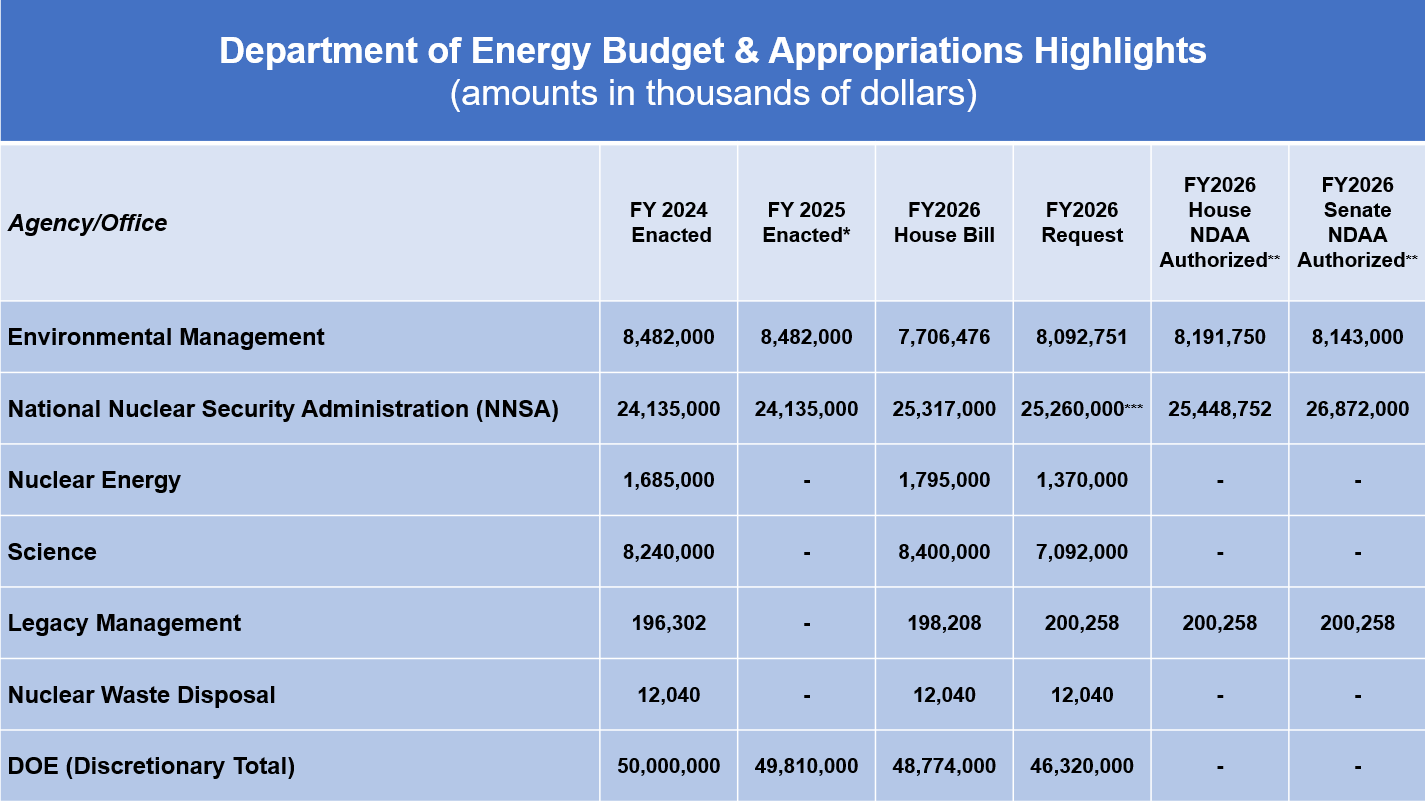
- Continuing Resolution Ends January 30 – no path for Energy and Water Appropriations Bill in the Senate….Yet
- National Defense Authorization Bill expected to move after Thanksgiving.
- DOE announced a loan to restart Three Mile Island with a potential to restart by 2027 - read more below.
- Oklo fuel facility receives design approval
- Join ECA to learn more about Advancing New Nuclear with Datacenter Development on December
4!
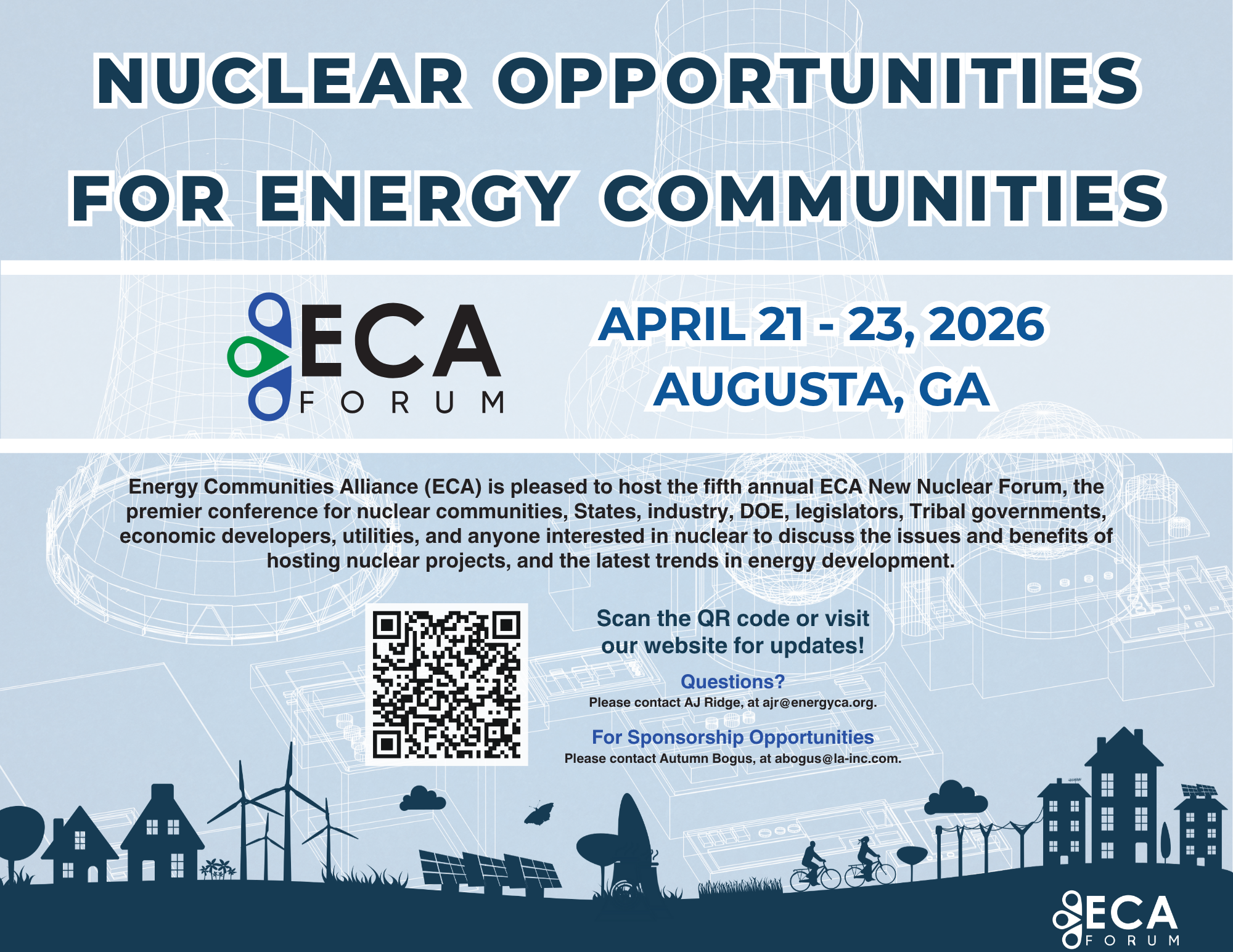
- ECA New Nuclear Forum to be hosted in Augusta, GA from April 21-23, 2026.
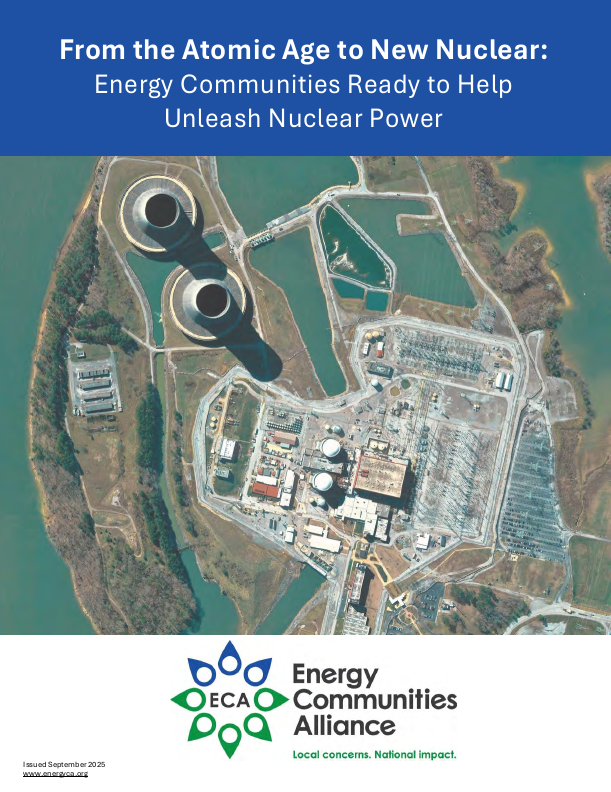
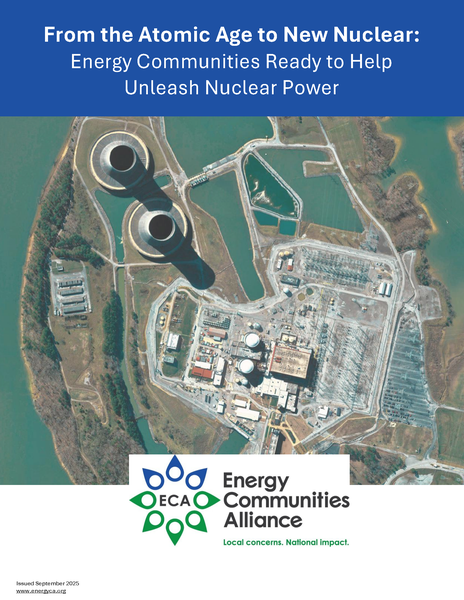
- ECA's latest report "From the Atomic Age to New Nuclear" highlights new nuclear projects across the country - see more below.
- Visit ECA on LinkedIn for regular updates.
DOE NUCLEAR WASTE FUND'S 2025 FINANCIAL STATEMENT AUDITThe Office of Inspector General has issues a report titled "The Department of Energy Nuclear Waste Fund's Fiscal Year 2025 Financial Statement Audit". As of September 30, 2025, cumulative billings from
fees and the Defense Nuclear Waste Disposal Appropriation (DNWDA), totaled approximately $25.5 billion; and cumulative interest earnings and other revenue totaled approximately $40.3 billion. As of September 30, 2025, cumulative expenditures by the Department from appropriations and amounts authorized by Congress, including direct appropriations to the NRC, the now defunct Office of Nuclear Waste Negotiator, and the Nuclear Waste Technical Review Board totaled approximately $11.5 billion. As of September 30, 2025, the U.S. Treasury securities held by the Nuclear Waste Fund (NWF) were $51.4 billion, and had a fair value of $51.3 billion. Offsetting NWF investments and receivables are deferred revenues, which reflect the cumulative fees billed, related accrued interest, and investment income in excess of expenditures since inception. As
of September 30, 2025, the combined deferred revenue balance was $54.2 billion. The increase from investment income and net gains from the maturity of securities was $1.9 billion for FY 2025. The Department estimates the remaining liability associated with the partial breach of the Standard Contract and has reflected that amount on the Commitments and Contingencies line of the balance sheet. As of September 30, 2025,
the estimate of the remaining liability from SNF litigation as $38.6 billion. Judgements and settlements for damages related to the partial breach are paid by the Judgement Fund. There were no formal recommendations for this particular review. As such, there was no formal response required. Read the full audit here.
DOE LOAN TO RESTART THREE MILE ISLANDThe U.S. Department of Energy on Tuesday closed on a $1 billion loan to restart Constellation Energy’s 835-MW Crane nuclear unit in Pennsylvania. Constellation plans to sell power from the unit to Microsoft under a long-term contract. Inspections of key components at the unit, formerly Three Mile Island Unit 1, and regulatory reviews are on schedule, Constellation said Tuesday. The Baltimore-based company expects to spend about $1.6 billion — about $1,916 per kilowatt — to restart the unit, possibly as soon as in 2027. “Constellation’s restart of a nuclear power plant in Pennsylvania will provide affordable, reliable, and secure energy to
Americans across the Mid-Atlantic region. It will also help ensure America has the energy it needs to grow its domestic manufacturing base and win the AI race,” Energy Secretary Write said. Read the full story here.
OKLO FUEL FACILITY RECEIVES DESIGN APPROVALThe Nuclear Safety Design Agreement for the Aurora Fuel Fabrication Facility, where the fuel for Oklo's first commercial-scale Aurora powerhouse will be made, is the first under the US Department of Energy's Fuel Line Pilot Projects initiative and was approved in just under two weeks. Oklo was named in late September as one of four companies selected by the Department of Energy (DOE) for its Fuel Line Pilot Program to build advanced nuclear fuel lines. This was established in May under an executive order from the president to establish a domestic nuclear fuel supply chain for testing new reactors, including those in the DOE's Reactor Pilot Program which aims to have at least three reactors achieve criticality
by 4 July 2026. One of the reactor projects selected for that programme is Oklo's Aurora-INL, a sodium-cooled fast reactor which is to be built at Idaho National Laboratory (INL). The DOE's Idaho Operations Office has approved the Nuclear Safety Design Agreement for the Aurora Fuel Fabrication Facility - the A3F - where the initial core for Aurora-INL will be made. The swift approval of the Nuclear Safety Design Agreement by the DOE's Idaho Operations Office helps demonstrate a new authorisation pathway. The authorisation process provides a "modernised approach to building and operating nuclear fuel production lines for research, development, and demonstration purposes, while also offering an accelerated route for advanced reactor developers", Oklo said. Read the full story here.
OAK RIDGE OFFICE OF ENVIRONMENTAL MANAGEMENT ADVANCE CLEANUPThe Oak Ridge Office of Environmental Management (OREM) made strides moving environmental cleanup and reindustrialization forward across Oak Ridge with the help of contractors United Cleanup Oak Ridge (UCOR) and Isotek in the fiscal year that recently ended. Employees pushed forward wide-ranging projects, including building deactivation, demolition, waste processing and disposal, and reindustrialization. OREM’s progress is removing hazards, reducing inventories of nuclear material, and opening land for national security and research missions, and new economic growth. Crews are approaching the halfway mark on the Alpha-2 demolition
project. Taking down the 2.5-acre former uranium enrichment facility is the largest teardown yet at the Y-12 National Security Complex, and its removal provides much needed space for new infrastructure to support national security missions. Workers are also busy preparing for other Y-12 demolition projects. They are in the final stages of deactivating Beta-1 and the early stages of cleanup in the massive Alpha-4 building.
Both are Manhattan Project-era uranium enrichment facilities. Read the full story here.
ARMY NAMES NINE INSTALLATIONS THAT COULD BE CHOSEN FOR NUCLEAR MICROREACTOR PROJECTThe Army on Tuesday named nine U.S. installations that could receive nuclear microreactors in the coming years as the service looks to the technology for increased and more resilient power production on its bases. The locations that could receive microreactors by 2030 as part of the Army’s new Janus Program are: Fort Benning, Ga.; Fort Bragg, N.C.; Fort Campbell, Ky.; Fort Drum, N.Y.; Fort Hood, Texas; Fort Wainwright, Alaska; Holston Army Ammunition Plant in Tennessee; Joint Base Lewis-McChord, Wash.; and Redstone Arsenal in Alabama. Army Secretary Dan Driscoll announced the Janus Program
last month, pledging to partner with commercial industry to place the small nuclear power reactors on some of the Army’s posts which will require more power access in the decades to come as the service increases its use of artificial intelligence capabilities and new-age weaponry. Driscoll and other officials last month declined to name what installations they were considering for the microreactors. The nine sites
were chosen after an evaluation of “mission critical installations, energy requirements and resiliency gaps, power infrastructure, environmental and technical considerations,” the service said in a news release Tuesday. Officials said it was possible that not all the named installations would receive microreactors in the coming years, but the Army envisions placing them at many more installations in the coming decades. “These early site selections align with the Department of War’s goal of accelerating the pace of deploying on-site nuclear generation at our installations,” Jordan Gillis, the Army’s assistant secretary for installations, energy and environment, said in a prepared statement. “Through the use of the Army’s unique nuclear regulatory authorities, we are deploying a resilient, secure and reliable energy supply for critical defense operations and in support of the most lethal land-based
fighting force in the world.” Read the full story here.
JOIN ECA FOR OUR NEXT WEBINAR "ADVANCING NEW NUCLEAR WITH DATACENTER DEVELOPMENT"
The next installment of ECA's Winter Webinar Series continues with "Advancing New Nuclear with Datacenter Development" on December 4 at 2:00pm ET. As artificial intelligence and cloud computing drive exponential growth in electricity demand, data center developers are turning to
nuclear energy for reliable, carbon-free power needed to operate continuously. This session explores the concerns local officials must address when co-locating data centers with existing or new nuclear generation. Speakers will discuss regulatory considerations, what makes an “ideal” site, community engagement, and partnership models that align digital infrastructure expansion with public safety and sustainability goals. Please contact AJ Ridge, ECA Director of Programs, with any questions at [email protected]. Click here for more information about upcoming events!
NEW NUCLEAR DEVELOPMENT HIGHLIGHT: PENNSYLVANIA
In ECA’s latest paper, “From the Atomic Age to New Nuclear,” ECA captures a snapshot of the nuclear projects underway in the United States by state including both federal and private
sites, and lays out the attributes that make energy communities optimal for this new era of American nuclear leadership. Keep reading what new nuclear projects are already underway in the great state of Pennsylvania in the excerpt below: Three Mile Island Restart - Constellation’s Crane Clean Energy Center has initiated a $1.6 billion project to restart Three Mile Island Unit 1 to provide power to Microsoft
data centers, aiming for the unit to be online by 2028. The reactor, shut down in 2019 due to economic concerns, will provide power to Microsoft under a 20-year power purchase agreement. The Crane Clean Energy Center will employ more than 600 full-time workers, and more than 200 full-time workers have already been hired, among them as many as 150 employees’ who previously worked at the plant. The Brattle Group conducted an independent economic impact study for the Pennsylvania State Building and Construction Trades Council estimating the restart will add more $16 billion to the state’s GDP. Learn more about the project here. To learn more about New Nuclear projects in Pennsylvania and across the country, as well as how energy communities will be instrumental to their
success, click here to read From the Atomic Age to New Nuclear.
ECA NEW NUCLEAR FORUM TO BE HOSTED IN AUGUSTA, GA FROM APRIL 21-23, 2026
Energy Communities Alliance (ECA) is pleased to host the fifth annual ECA Forum in Augusta, GA from April 21 - April 23, 2026. The meeting is part of ECA’s ongoing New Nuclear Initiative to define the role of local governments in supporting the development of the new nuclear technologies. April 21 | Registration Opens & Nuclear 101 April 22 | Full Day General Session April 23 | Half-Day General Session The ECA Forum is the only meeting designed to bring together DOE, federal, state, local and tribal governments and policymakers with developers, utilities, regulators, industry, and academia to identify opportunities, challenges and to build the partnerships necessary to support nuclear development. Stay tuned for further details on registration, agenda, and
more! WHO SHOULD ATTEND?
The ECA Forum is open to communities, State, Tribal and local policymakers, industry, utilities, developers, experts, financiers, state legislators, community groups, and economic development organizations working to build capacity and support for new nuclear development in the U.S. AGENDA:
Agenda coming soon! ECA is working with private and community partners to develop an agenda that continues to look holistically at the what a nuclear project entails: from the front-end of the fuel-cycle to the back-end of the fuel cycle, from building local support, to state support and enabling legislation, from identifying the right public-private partnerships, to understanding
regulatory oversight.
WHAT YOU'VE MISSED: Fusion Energy Is Happening Now: The Global Race to Commercialization The House Science, Space, and Technology Committee recently held a hearing on the state and future of fusion power—a clean, secure, and virtually limitless form of energy. Witnesses from the fusion industry, our National Labs, and academia detailed how advances in materials science, artificial
intelligence, and high-temperature superconductors are rapidly accelerating progress toward commercial fusion. Read
the full story Beyond Nuclear brings interim storage case back to Supreme Court The U.S. Supreme Court may once again scrutinize the Nuclear Regulatory Commission’s authority to license consolidated interim storage facilities for commercial spent nuclear fuel. The group Beyond Nuclear has filed a petition with the court for a writ of certiorari review of an August 2024 appeals court decision rejecting the group’s lawsuit against the licensing of Holtec International’s New Mexico storage facility, the HI-STORE CISF. Read the full story
Marketplace October 27, 2025 The nuclear technology company Kairos is using molten salt cooling, a technique originally developed in the mid-20th century, to advance the safety and reliability of small, modular nuclear reactors, according to journalist Mark Harris. Some AI companies are turning to nuclear power to meet demand for electricity. But traditional nuclear plants can take decades to bring online. Now some tech companies are partnering with startups trying to build small, modular nuclear reactors, designed with speed in mind. One such company, Kairos, has a deal with Google to build a fleet of modular reactors. To do so, it’s
relying on a technique first developed in the mid-20th century: molten-salt cooling. Marketplace’s Nova Safo spoke with journalist Mark Harris, who wrote about Kairos for MIT Technology Review, to learn more. Listen Here Gone Fission Podcast October 27, 2025 While many companies--foreign and domestic--are engaged in advancing the nuclear renaissance, one company stands out for its reputation and deep involvement in the evolution of commercial nuclear power over a period of decades. In this week’s episode, host Michael Butler takes a look at what Bechtel is doing today to further advanced nuclear technology in the U.S. and abroad. Our guest is Ahmet Tokpinar, Principal Vice President and General Manager of Bechtel’s nuclear power
business iine. We’ll also have more from Mike Deane, the “Nuclear Average Joe”, who’s burning up the internet with his easy-to-digest layman’s take on the benefits of nuclear power. Listen Here
|
|