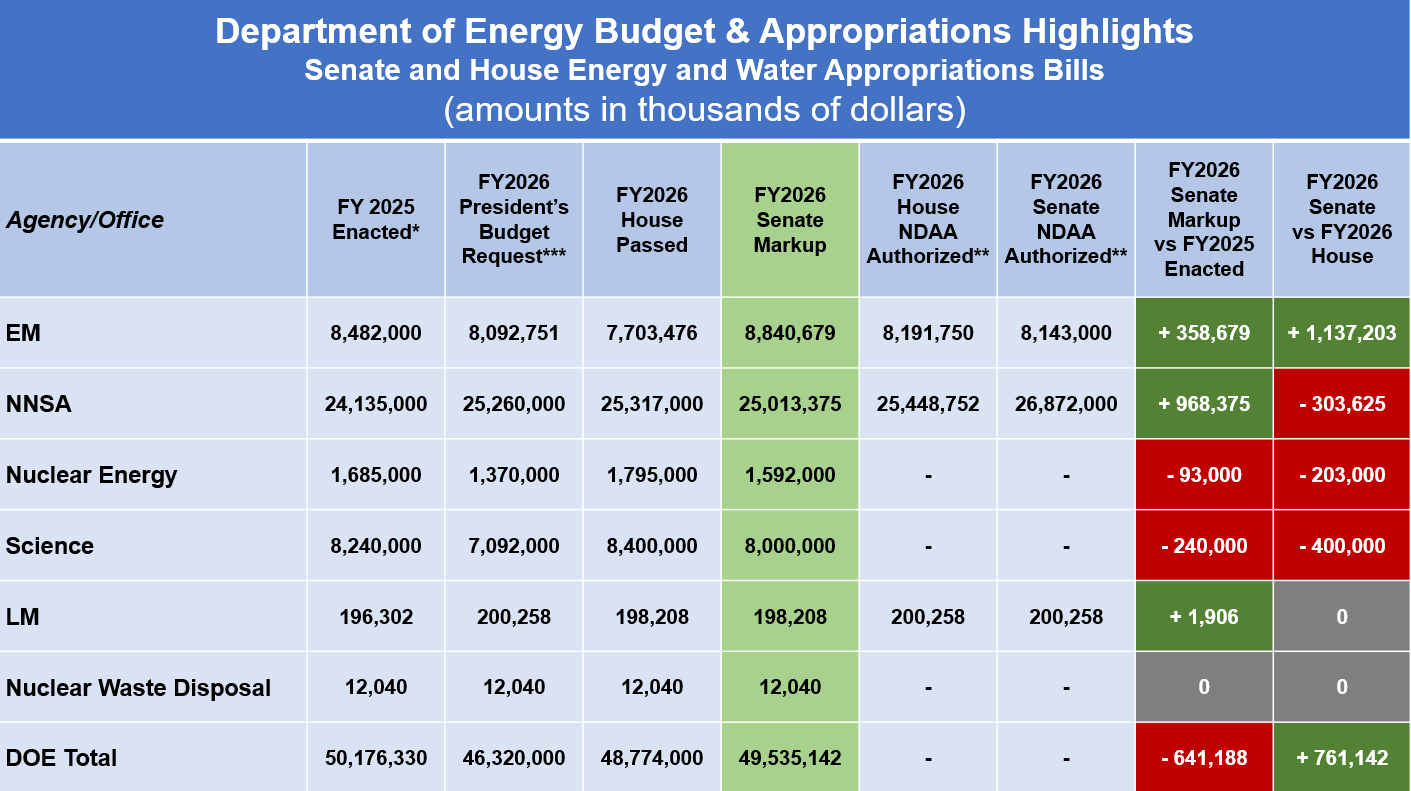
Yesterday, Senate appropriators released text of the Energy and Water Development bill. The House released its bill back in July (H. Rept. 119-213). The House and Senate
have significant differences.
ECA has identified highlights of the Senate Committee report language and included key provisions related to NE, EM, NNSA below. Note, the identification of a federal interim storage facility, micro reactor development at a DOD facility in Alaska, public private partnership for reprocessing language, new nuclear energy and fuel language, Hanford cleanup (and not to use the HLW
interpretation), and weapons production language:
Nuclear Energy
The Committee recommends $1,685,000,000 for Nuclear Energy. Within available funds, the Committee recommends $90,000,000 for program direction.
Additional direction related to
Department-wide crosscutting initiatives is provided in front matter for the Department of Energy.
Integrated Waste Management System.—The Department is directed to move forward under existing authority to identify a site for a Federal interim storage facility. The Committee was pleased to see the Mission Need Statement [CD–0] for the Federal Consolidated Interim Storage Facility, initiating the major
acquisition project process for the Department. The Department is further directed to use a consent-based approach when undertaking these activities.
The Department is reminded that the Nuclear Waste Policy Act provides for a wide variety of activities that may take place prior to the limitation in that act.
The Committee
directs the Office of Nuclear Energy to work with the Arctic Energy Office to facilitate Department of Defense deadlines for deployment of a micro-reactor. Further Committee direction is provided in Departmental Administration
Advanced Nuclear Fuel Availability.—The Committee notes that section 312 of the fiscal year 2024 act provided up to $2,720,000,000 for nuclear fuel availability. The Committee supports
the Department’s ongoing efforts to implement section 312 of the fiscal year 2024 act, and is encouraged by the momentum within the domestic uranium production industry. The Committee continues to emphasizes the critical importance of maintaining a stable and domestic supply of HALEU to advance the development of nuclear reactors and strengthen national security through energy independence, and support and prioritize commercialization activities associated with laser enrichment
technology and novel separation and enrichment methods in furtherance of expanding U.S. supply. The Committee directs the Department to provide a report not later than 90 days after enactment of this act, to the appropriate authorizing and appropriating committees of the Senate and the House of Representatives, outlining Departmental plans to implement the Nuclear Fuel Security Act and execute fiscal year 2024 provided funds to boost domestic nuclear fuel availability.
Material Recovery and Waste Form Development.—The Committee encourages the Department to support the ZIRCEX process. The Idaho National Laboratory is storing spent nuclear fuel from the Advanced Test Reactor [ATR] that could be processed into HALEU for use in advanced reactors. The Committee recommends up to $8,000,000 to develop a process of converting ATR spent fuel into HALEU metal and possibly oxide beginning in 2029 and
producing a minimum of one MTU of HALEU per year.
The Committee recommends funding for public-private partnerships piloting ways to repurpose spent nuclear fuel for use in new energy applications and radioisotope harvesting. Within available funds, the Committee recommends commercial-scale research projects related to the following priority topics: technology demonstration of aqueous recycling,
as defined as processing of greater than 100 metric tons annually of UNF; production of MOX or HALEU feedstock; and recovery of critical isotopes for use in medicine, industry or defense.
Advanced Small Modular Reactor Research, Development, and Demonstration.—The recommendation includes further funding for small modular reactor demonstration projects derived from
unobligated emergency appropriations funding.
The Department is again directed to provide to the Committee, not later than 90 days after enactment of this act, a briefing on the Tennessee Valley Authority’s nuclear project at the Clinch River Nuclear site, including: the Department’s investment to date in the TVA Clinch River Nuclear site and a detailed breakdown of what further Federal support would be
needed to deploy new nuclear technology at the Clinch River Nuclear site
The Committee recommends up to $30,000,000 for MARVEL. The Committee notes that MARVEL is a capital acquisition project, and the Department is directed to treat it as such. The Committee looks forward to a future budget request that properly requests funds for this capital acquisition project.
The Committee provides up to $5,000,000 to support the development of technical capabilities, infrastructure, and technology development for space-based nuclear reactor systems.
Integrated Energy Systems.—The Committee recommendation provides up to $9,500,000 for integrated energy systems, including projects with hydrogen co-located
with nuclear
Regulatory Development.—Within available funds, the Committee recommends up to $15,000,000 for the Advanced Nuclear Licensing Energy Cost-Share Grant Program as authorized under 42 U.S.C. 16280. The Department shall coordinate this work with financial and technical assistance for reactor siting feasibility studies activities.
The Committee supports the Department’s goal to deploy innovative advanced reactor technologies and encourages the Department to work in coordination, not in circumvention of the Nuclear Regulatory Commission’s existing licensing authorities. Further, before entering into any agreement to authorize a nuclear reactor under the auspices of the Department pursuant to 42 U.S. Code 2140 (a)(2), the Department of Energy shall notify the
Committee at least 30 days prior to entering an agreement and provide a plan that addresses financial indemnification requirements, inspection and oversight costs to be incurred during the reactor’s operations, and decommissioning costs, specifically addressing the outyear costs and the need for any future appropriations.
Defense Environmental Cleanup
The Committee recommendation for Defense Environmental Cleanup is $7,627,779,000.
Within available funds, the Department is directed to provide $10,000,000 for the National Institute of Environmental Health Sciences/Department of Energy Nuclear Worker
Training Program.
Richland.—The Committee reminds the Department that while Hanford’s tank waste mission is directly tied to commitments between the Department, the Environmental Protection Agency, and the Washington State Department of Ecology, Richland is integral to the health and success of Hanford overall and must receive the support it needs.
The Committee remains concerned about risks stemming from contamination beneath Building 324 and directs the Department to consider conducting additional groundwater monitoring in this area. Further, the Committee provides $5,000,000 for the preservation of historic structures at the Hanford site associated with the Manhattan Project National Historical Park. Within 90 days of enactment of this act, the Department, in coordination with the National Park Service, shall provide
the Committee with an updated list of preservation projects at the site, in priority order.
Volpentest Hazardous Materials Management and Emergency Response Federal Training Center.—The Committee recognizes that the Volpentest Hazardous Materials Management and Emergency Response Federal Training Center [HAMMER] offers nationally recognized,
comprehensive safety and emergency response training for workers across the Department’s complex and beyond. Therefore, the Committee encourages the Department to prioritize HAMMER to the greatest extent possible, including for training needs associated with the Waste Treatment Plant.
Office of River Protection.—The Committee recommends $2,443,812,000
for the Office of River Protection. Funding above the request is provided for design, engineering, procurement, and construction of the High-Level Waste Treatment Facility, the first full year of operations of the Direct-Feed Low-Activity Waste facility, and other projects essential to the tank waste mission. The Committee notes that the Department has reached a holistic agreement with the Environmental Protection Agency and the Washington State Department of Ecology. The Department is reminded
that compliance with this agreement will require significant funding increases in future years. The Department is directed to request adequate funding to meet the obligations laid out in the holistic agreement in future budget requests.
Further, the Department is reminded that the holistic agreement includes forbearance from applying the
Interpretation of the Definition of High-Level Radioactive Waste (86 Fed. Reg. 72220) to Hanford tank waste. The Committee notes that that holistic agreement also includes a path forward for the grouting of tank waste beyond the quantities outlined in Phase II of the Test Bed Initiative. Should the Department revisit the application of the High-Level Waste interpretation to Hanford tank waste, the Department shall brief the Committee within 15 days of submitting a budget request or other public
document that articulates a formal change of course in Departmental policy regarding the High-Level Waste interpretation.
Hexavalent Chromium Plume (Los Alamos National Lab).—The Committee is pleased to see the Office of Environmental Management [EM] moving forward with plans to place a well on Pueblo de San Ildefonso land. Originally
discovered in 2004, the hexavalent chromium plume beneath Mortandad and Sandia Canyons at Los Alamos National Lab, should remain a top priority for EM. The Committee recognizes the efforts that went into restarting partial operations of the Chromium Interim Measures [IM] in September 2024 in alignment with authorization by the New Mexico Environment Department [NMED] and is pleased to note the decrease in chromium concentrations at and near IM operation wells. To date, the IM has successfully
removed 750 pounds of chromium and treated over 480 million gallons of groundwater. The Committee encourages EM to engage with affected communities directly, and to brief the Committee on the efforts to incorporate community engagement into the IM process.
Waste Isolation Pilot Plant.—Waste Isolation Pilot Plant
[WIPP] road infrastructure funding was provided to the State of New Mexico with section 15(a) of the WIPP Land Withdrawal Act [LWA] (LWA, Public Law 102–579, as amended by Public Law 104–201) from 1999 through 2012. Provisions of section 15 of the LWA included payments to New Mexico of $20,000,000 annually indexed for inflation, for a 14-year period. The Committee continues to recognize the importance of well-maintained roadways throughout approved transportation routes for promoting public
safety and safe transportation of transuranic waste to the WIPP. A September 2023 Department of Energy Report, ‘‘Evaluation of New Mexico Roadway Condition and Usage in Support of the Waste Isolation Pilot Plant,’’ found that 59 percent of WIPP routes are rated as ‘‘fair’’ or lower, with 21 percent rated as ‘‘poor.’’ The deteriorated roadway conditions near WIPP pose a safety risk to both WIPP staff and transuranic [TRU] shipments. Given the deteriorated conditions of roadways, the
Committee recommends the Department make a voluntary payment of $20,000,000 in fiscal year 2026 to the State of New Mexico for WIPP route related road infrastructure projects. These funds shall only be used for projects mutually agreed to by the Department and the State of New Mexico.
Oak Ridge Reservation.—The Office of Environmental
Management [EM] continues to support the Department of Energy’s science and defense missions at Oak Ridge through environmental remediation, demolition of excess facilities, and the disposition of legacy and newly generated waste. The Committee encourages the respective programs to continue to work together effectively and efficiently to ensure cleanup of sites and managing waste. The Department is directed to brief the Committee within 120 days after enactment of this act on EM’s ongoing
operations at Oak Ridge, to include the costs of EM’s activities, use of EM facilities in Oak Ridge by other programs or sites, and current cost sharing arrangements.
Consortium for Risk Evaluation with Stakeholder Participation.—The Committee recommends up to $5,000,000 for the existing cooperative agreement with the Consortium for Risk Evaluation
with Stakeholder Participation [CRESP] for independent review, analysis, applied research and educational initiatives to support cost-effective, risk-informed cleanup decision-making. Further, up to $2,000,000 is provided to CRESP for independent academic expertise for waste management and remediation for the Oak Ridge Reservation.
Containment
Ventilation Systems.—The Committee recommends up to $7,000,000 for work on qualification, testing, and research to advance state-of-the-art containment ventilation systems. The Department is directed to brief the Committee on its progress and any future budget requirements necessary to address the Department’s other research and technology development challenges within 120 days of enactment of this act.
National
Nuclear Security Administration
The NNSA maintains that its mission is driven by military requirements and the world landscape. But too often the NNSA has over-promised, over-spent, and under-delivered on its important commitments. It is imperative, both in responsibility to the taxpayers and our national security, that the NNSA maintain its focus on improving the management of projects
and programs. This responsibility is not without a roadmap. The Government Accountability Office [GAO] has made numerous recommendations to the NNSA to improve management of its projects and programs. As of July 1, 2025, GAO considers 86 recommendations it has made to the NNSA as open. Some of these recommendations have remained open since 2018. The Committee therefore directs the NNSA to continue providing quarterly briefings on the status and progress of GAO’s open
recommendations. These briefings shall detail the actions the NNSA has taken or plans to take to address each open recommendation, timeframes for completion, and any barriers to implementing the recommendation.
Los Alamos National Laboratory Road Safety Analysis.—The Committee is aware that the DOE Office of Enterprise Assessment conducted an independent assessment of motor vehicle safety at Los Alamos
National Laboratory [LANL] and provided an initial outbrief to the NNSA Los Alamos Field Office in April 2025. The NNSA is directed to finalize the draft report associated with this independent assessment and brief the Committee on the assessment and road safety issues around LANL, particularly on the portions of highways NM–4, NM–501, and NM–502 within 25 miles of the laboratory. The briefing should include a description of any actions taken by the NNSA, Los Alamos County, and the New Mexico
Department of Transportation since January 1, 2024, to improve vehicle and pedestrian safety in the vicinity of the laboratory, as well as any ongoing or planned road safety improvements. The briefing should also include an overview of the collaboration to date with Los Alamos County and the New Mexico Department of Transportation and plans to continue collaboration moving forward.
NNSA’s Efforts to Ensure Program
Affordability.—The Committee commends the NNSA for its emphasis on portfolio management processes and decision analysis tools to support the Weapons Activities portfolio. However, the Committee does not have full visibility into the suite of capabilities that the NNSA employs to evaluate program and project priorities, tradeoffs, and alternatives under consideration as it prepares its annual budget request and the Future Years Nuclear Security Program. The Committee directs GAO to review the
tools and processes the NNSA uses to assess tradeoffs in development of its budget requests and outyear budget projections, and the actions the NNSA has taken using those tools and processes to ensure an affordable nuclear modernization program of record. The Committee directs GAO to provide a preliminary briefing to the House and Senate Appropriations Committees within 60 days of the enactment of this act and provide a final report at a future date agreed to at the time of the
briefing.
Project and Program Management. — The Committee is concerned with NNSA’s continued inability to properly estimate costs and timelines for large projects. The NNSA is encouraged to assess current performance on projects costing more than $750,000,000 and make appropriate project management changes. The Committee directs the NNSA to disclose problems in cost and schedule estimates within 30 days of discovery,
and to provide quarterly (or more frequent) briefs to the Committee leading up to any project baseline change proposal.
NNSA Project and Program Executability.—Given the additional resources NNSA received under Public Law No. 119–21 in addition to the funds made available under this act, the Committee is concerned with the NNSA’s ability to efficiently execute an influx of resources given significant ongoing
challenges such as limits to craft labor and supply chain limitations that could result in a pooling of large carryover balances that could persist for years. For these reasons, the Committee directs GAO to undertake a review of NNSA’s execution of appropriations, additional funding provided through Public Law No. 119–21, and any remaining available prior year appropriations, including: (1) any NNSA plans for expending available funding during fiscal year 2026; (2) NNSA’s obligation rates and
amounts of any actual or projected unobligated carryover; and (3) NNSA’s expenditure rates and amounts of any actual or projected unexpended carryover. The Committee directs GAO to begin this work immediately upon enactment and provide a briefing to the House and Senate Appropriations Committees no later than April 2026 summarizing its preliminary observations of NNSA’s budget execution through the first quarter of fiscal year 2026. GAO should provide a final report to the Committees no later
than February 2027. The Committee directs NNSA to provide a briefing on finalized spend plans for the resources that NNSA received under Public Law No. 119–21 immediately upon enactment of this act.
The Committee recommends $20,074,400,000 for Weapons Activities to ensure the safety, security, reliability, and effectiveness of the Nation’s nuclear weapons stockpile without the need for underground nuclear
testing.
Plutonium Pit Production.—The committee strongly supports the Department’s efforts to restore domestic production capabilities to meet the statutory requirement of producing 80 war reserve pits per year. The Committee urges the Department to work expeditiously to meet this goal in a timeline that supports military requirements. However, the Committee remains concerned that the NNSA has not yet
completed a resource loaded Integrated Master Schedule [IMS] that meets minimum standards per GAO’s findings in 2023. The Committee encourages the NNSA to continue to prioritize the development of the IMS given the complexity of this production mission and the NNSA’s two site solution and directs the NNSA to deliver a briefing on the IMS immediately upon enactment of this act. Also, NNSA is directed to provide the Committee with a copy of the summer 2025 JASON Pit Aging study along with an
unclassified summary within 60 days of the report’s completion.
Stockpile Major Modernization.—While the Committee continues to support the development of a Sea Launched Cruise Missile-Nuclear [SLCM–N] warhead to meet military requirements, it is concerned with the lack of program specificity and the development of a comprehensive acquisition strategy. The NNSA is directed to pro-vide, in writing to
the House and Senate Appropriations Committee, a detailed and site-specific acquisition plan for the SLCM– N program through First Production Unit no later than 30 days after enactment of this act. In addition to NNSA specific scope, this acquisition plan shall also include the Navy’s program milestones and NNSA’s plans for schedule integration with the Navy.
The Committee recommends $2,431,007,000 for
Defense Nuclear Nonproliferation. The Defense Nuclear Nonproliferation program is critically important to our National security by preventing nuclear materials and weapons from falling into the wrong hands, including non-nuclear weapon States, terrorist organizations, and non- state actors. This program helps protect our Nation from emerging and ever evolving threats.
Surplus Plutonium Disposition.— The
Committee requests a brief from the Department on its progress toward implementing Executive Order 14302—Reinvigorating the Nuclear Industrial Base no later than 30 days after the enactment of this act. In particular, the Committee is concerned with the implications of this Order on the nonproliferation mission, as well as the impact on the Surplus Plutonium Disposition Project at the Savannah River Site.
Environmental Management
Non-Defense Environmental Cleanup
The Committee recommends $337,900,000 for Non-Defense Environmental Cleanup.
Gaseous Diffusion Plants.—The Committee recommends $155,120,000 for cleanup activities
at the Gaseous Diffusion Plants. Funding above the budget request is recommended for infrastructure improvements required for the shipping and disposal of oxide cylinders. The Committee recommends up to $30,700,000 for the transport and disposition of surplus depleted uranium oxide cylinders from the Paducah, Kentucky and Piketon, Ohio facilities. The Committee encourages the Department to accelerate disposal rates for this material to the maximum extent possible.
Small Sites.—The Committee recommends $89,500,000 for Small Sites. Within available funds, the Committee recommends $10,000,000 for the Energy Technology Engineering Center, $12,500,000 for Idaho National Laboratory, and $67,000,000 for Moab.
Brookhaven National Laboratory Cleanup.—The Committee encourages the office of Environmental Management [EM] to continue
discussions to determine how best to address Perfluoroalkyl and Polyfluoroalkyl Substances [PFAS], 1,4–Dioxane, and other contaminants, and determine the scope and cost of remediation activities. The Committee encourages EM to include necessary funding in future budget requests as the scope of remediation activities is more clearly defined.
The Committee recommends $875,000,000 for activities funded from the Uranium
Enrichment Decontamination and Decommissioning Fund.
Paducah Administrative Support Facility.—The Committee acknowledges the Department’s cost-benefit analysis that demonstrates the need to replace the 70-year-old C–100 Program Support Facility at the Paducah site. The Committee directs the use of $41,000,000 within available funds from the Uranium Enrichment Decontamination and Decommissioning Fund to support
planning, design, and construction of the new facility. The Committee recommends that the Department execute these funds as a single, integrated construction project.
Uranium Bartering.—The Department shall not barter, transfer, or sell uranium to generate additional funding for environmental management activities in fiscal year 2026.