TODAY'S HIGHLIGHTS & WHAT TO KNOW THIS WEEK
- New report released titled: "The Path Forward for Nuclear Waste in the U.S." outlines recommendations to break the current stalemate and address spent nuclear fuel (SNF) and high-level waste (HLW) management and disposition. - read more below.
- NASA, DOE solidify collaboration for a nuclear
fission reactor on the lunar surface to provide power for future missions by 2030 - read more below.
- DOE establishes Center for Used Fuel Research at Idaho National Laboratory - read more below.
- Holtec submits partial construction permit application for SMRs at Palisades - read more below.
- DOE announces Environmental Management Site-Specific Advisory Board (EM SSAB) meetings at Hanford, Nevada, and Portsmouth - read more below.
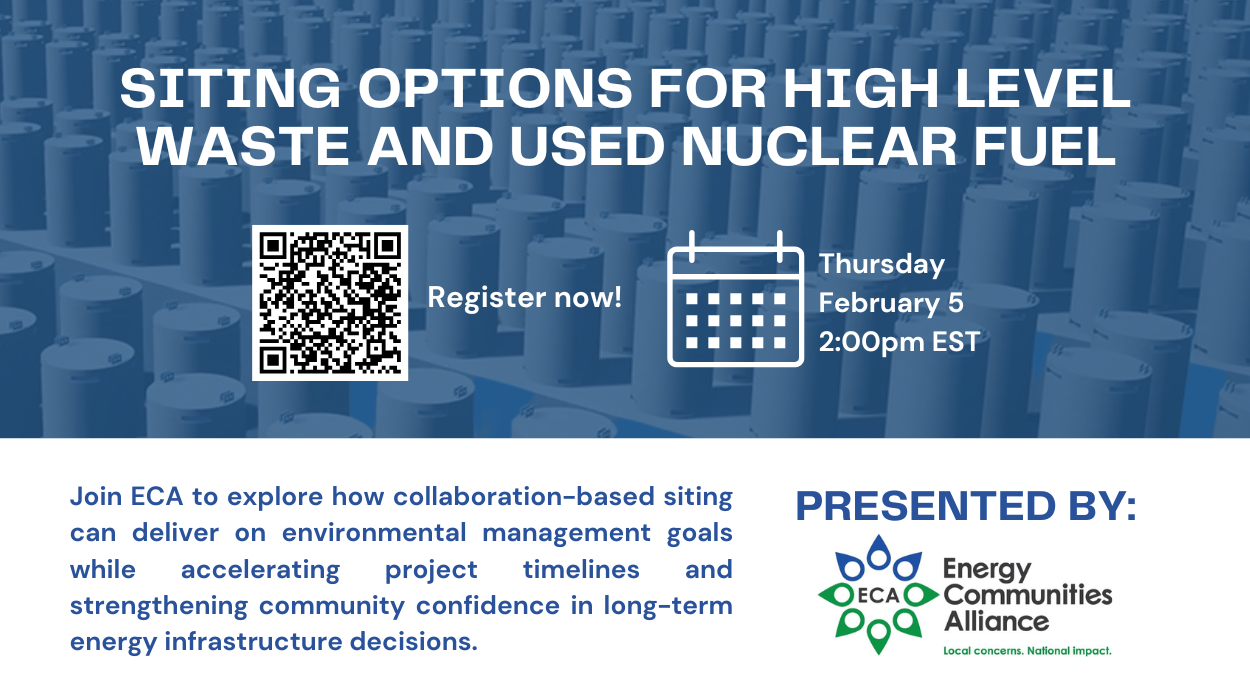
- Register today for ECA's next
webinar, "Siting Options for High Level Waste and Used Nuclear Fuel" on February 12 at 2:00pm EST.
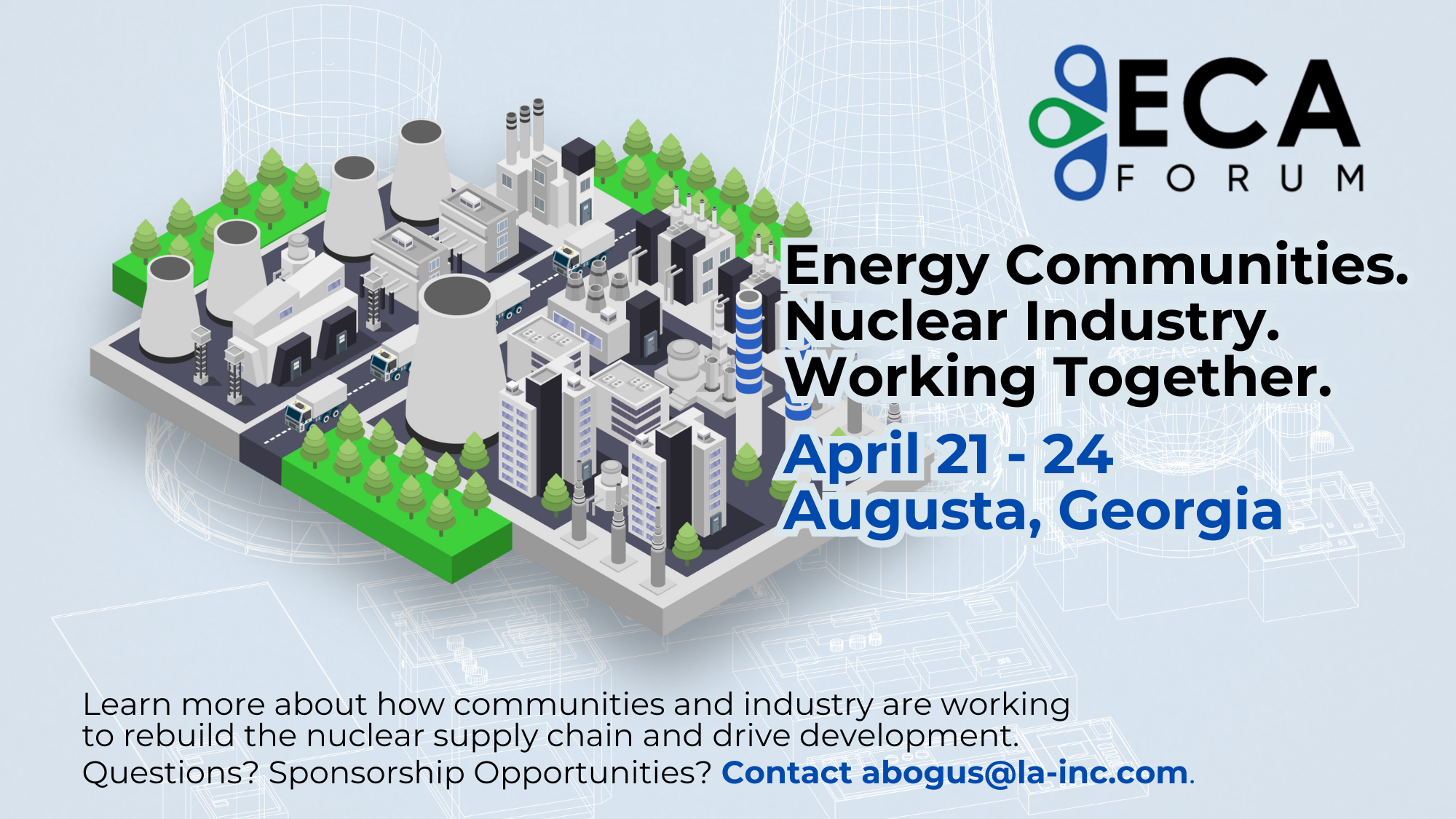
- ECA New Nuclear Forum
- 📅 Date: April 21-24
📍 Location: Augusta, GA 🔗 Register Here!
- Join us for insights, industry networking, and expert speakers from the people advancing new nuclear reactors across the United States. Whether you’re looking to begin learning about nuclear energy or
to deploy advanced reactors in your region, this is the place to be. Don’t miss out—secure your spot today!
- Visit ECA on LinkedIn for regular updates.
REPORT RELEASED: A NEW PATH FORWARD FOR NUCLEAR WASTE IN THE U.S.Today a group of nuclear experts released a new report, “The Path Forward for Nuclear Waste in the U.S.,” outlining recommendations to break the current stalemate and address spent nuclear fuel (SNF) and high-level waste (HLW) management and disposition. The timing of the report is essential: as the country actively pursues new nuclear development at home and to export our advanced technologies abroad, a new strategy is essential to tackle the challenges of the back of the fuel cycle. The steering group, which includes ECA’s Director of Nuclear Programs, was led by Lake Barrett, the previous head of DOE’s former Office of Civilian Radioactive Waste Management (OCRWM), and Allison Macfarlane, former Chair of the Nuclear Regulatory Commission (NRC) and member of the Blue Ribbon Commission on America’s Nuclear Future, addressed key issues including governance, access to funding, siting, the role for states, local governments and Tribes, and
debated changes needed to existing nuclear waste legislation in order to make meaningful progress. Recommendations include: - Establishing “NuCorp” rather than the U.S. Department of Energy to manage and dispose of SNF and HLW. NuCorp would be a nuclear reactor owner-led corporation – either as an independent public benefit corporation or a non-profit corporation - with a Board of Directors
and an independent Advisory Committee to include affected state, local and Tribal representatives; as well as technical and social science experts to provide oversight.
- Fixing the financing through legislation that provides NuCorp initially with access to the interest earned on the existing Nuclear Waste Fund (currently around $1.8 billion per year) to get started, and any monies not used in a given year, moved into an escrow account for future use.
Eventually, access to the full corpus will need to be ensured through additional legislation.
- Requiring development of a Mission Plan within one year to provide a roadmap to the ultimate permanent disposal of SNF and HLW, including objectives, planned outreach and collaborative engagement approaches, schedule goals, and conceptual plans for siting, design, licensing, construction, operation and decommissioning of one (or more) geologic repositories and a consolidated
interim storage facility as a bridging pathway towards disposal and reducing taxpayer liability costs.
In parallel with the initial first draft of the Mission Plan, DOE must provide NuCorp and Congress with a report on DOE’s legacy waste, including volume and characteristics of waste requiring disposal in a geologic repository. While DOE will not be required
to contract with NuCorp should alternative disposal paths be identified, if DOE does choose to use NuCorp, it would be obligated to manage and dispose of DOE’s HLW and SNF. - Developing updated generic radiation standards and licensing regulations for a repository and requiring, through legislation, that the U.S. Nuclear Regulatory Commission and the Environmental Protection Agency work together to do so.
The report also outlines best practices that have led to successful siting efforts elsewhere, including those ECA has identified in the past: ensuring appropriate benefits for a host community, transparency, flexibility, an ability to opt-out and resources for states, local communities or Tribes to hire their own independent experts to do their own analyses of the benefits and challenges. Ms. Colton noted ECA is pleased to support this renewed effort and to facilitate discussions on how best to collaborate across the nuclear ecosystem to realize the myriad benefits new nuclear development presents. “There are communities today raising their hands to explore hosting new nuclear projects, not only advanced reactors but also nuclear waste storage or recycling facilities. If
the country is to truly support and benefit from deploying advanced nuclear technologies, it is incumbent that the government take these essential steps to finally move forward and demonstrate that we can successfully address the whole nuclear fuel lifecycle – from beginning to end.” As the report concludes, “…we can do this.” Read the full article here.
NASA, DOE SOLIDIFY COLLABORATION ON A LUNAR SURFACE REACTORNASA and the Department of Energy have announced a “renewed commitment” to their mutual goal of supporting research and development for a nuclear fission reactor on the lunar surface to provide power for future missions. The agencies have signed a memorandum of understanding that “solidifies this collaboration and advances President Trump’s vision of American space superiority.” Uncertainties remain: an executive order released on December 18 that calls for “establishing initial elements of a permanent
lunar outpost by 2030 to ensure a sustained American presence in space and enable the next steps in Mars exploration.” Among those elements would be a nuclear reactor capable of producing “safe, efficient, and plentiful electrical power that will be able to operate for years without the need to refuel.” However, as with previous government statements about a U.S. lunar reactor, the latest DOE and NASA press releases include
uncertainties. They do not state specifically whether the reactor will actually be operating on the moon by 2030, or whether it might be built by then but not yet deployed. NASA’s and the DOE’s joint ambitions for a lunar fission surface power (FSP) system have been characterized by delays and uncertainties as shifting priorities have led to changing designs and schedules. Latest specs: According to an
August 2025 NASA request for information that was sent to several companies for feedback, the most recent FSP design would include the following specs: - Reactors should be prepared to launch by the first quarter of fiscal year 2030 (the last quarter of calendar year 2029).
- Reactor designers can assume the use of a heavy-class lander that can carry up to 15 metric tons.
- The reactor must have a 100-kWe output using a closed Brayton cycle power conversion system. NASA
prefers the Brayton cycle to “reduce risk and ensure extensibility to higher power systems.”
One of the greatest technical achievements: Secretary of Energy Chris Wright said of the new MOU, “History shows that when American science and innovation come together, from the Manhattan Project to the Apollo Mission, our nation leads the world to reach new frontiers once thought impossible. This agreement
continues that legacy. . . . the Department is proud to work with NASA and the commercial space industry on what will be one of the greatest technical achievements in the history of nuclear energy and space exploration.” Read the full press release here.
DOE ESTABLISHES CENTER FOR USED FUEL RESEARCH AT IDAHO NATIONAL LABORATORYYesterday, the DOE Office of Nuclear Energy announced the establishment of the Center for Used Fuel Research (Center) at Idaho National Laboratory (INL), officially designating INL as its leading institution for critical research, development, and demonstration efforts concerning used nuclear fuel (UNF) management. This strategic move underscores the DOE’s renewed commitment to solving one of the nation's
most pressing energy and environmental challenges and delivers on a key element of the 1995 Idaho Settlement Agreement establishing INL as the DOE lead used nuclear fuel research laboratory. The new Center is specifically designed to be a national and international hub for applied research on the management of UNF that supports and maintains compliance, and advances public confidence in the safe storage and
transportation of both commercial and DOE-managed UNF. This initiative directly addresses DOE’s statutory responsibility for the disposition of UNF and would not have been possible without DOE and the State of Idaho agreeing to a targeted waiver of the 1995 Settlement Agreement, which happened in April 2025. “Responsible management of used nuclear fuel is essential to the future of nuclear energy in the United
States,” said Assistant Secretary for Nuclear Energy Ted Garrish. As the lead institution, INL will coordinate a broad and diverse collaboration through a "hub-and-spoke" model. This network will encompass other national laboratories within the DOE complex, leading universities, and key industry partners across the United States. Crucially, the Center will also extend its support and actively collaborate with
international partners. DOE remains steadfast in its commitment to exploring actions necessary to renew, revitalize, and empower the next generation of nuclear energy, thereby securing vital energy resources for the United States. Read the full press release here.
HOLTEC SUBMITS PARTIAL CONSTRUCTION PERMIT APPLICATION FOR SMRS AT PALISADESOn New Year’s Eve, Holtec International submitted Part 1 of a construction permit application to the Nuclear Regulatory
Commission seeking a limited work authorization (LWA) to begin construction of a two-unit SMR-300 plant at the company’s site in Covert, Michigan. Named Pioneer-1 and -2, the twin 340-MWe pressurized water reactors would join the 777-MWe Palisades PWR that began operating in 1971, shut down in 2022, and is expected to reconnect to the grid—slightly delayed—early this year. According to Holtec’s application documents, Part 2
of its construction permit will be filed no later than mid-2027. On January 13, the NRC announced that the
submission—the first of an expected two-part construction permit application from SMR, LLC (a Holtec International subsidiary)—was available for review. The NRC staff is reviewing the application, and if it is sufficient the staff will docket it and set a schedule for a detailed technical review, which according to the NRC is “not to exceed 18 months.” One of Holtec’s key developments: In a review of its
business accomplishments in 2025, Holtec International highlighted some “pivotal breakthroughs” in its plans to deploy two SMR-300 small modular reactors at its Palisades site, including the award of $400 million from the Department of Energy in early December. Holtec reported that it expects to begin preparatory civil construction work at the site as soon as the Palisades reactor is reconnected to the grid, which is likely
by the end of February, according to the company (earlier estimates had Palisades set for restart by the end of 2025). LWA package details: Holtec “requests approval of the proposed LWA application by December 31, 2026,” and includes three separate exemptions in its application. Holtec asked that two of those exemptions—to permit
certain construction activities prior to a full construction permit and to exempt the applicant from requirements to identify specific sources of funding at this time—be reviewed and approved concurrently with the LWA application. Holtec has also requested a quicker six-month review schedule for an exemption request to allow the permanent installation of retaining walls, or excavation supports, prior to LWA approval. Once the LWA is approved, Holtec plans to “perform soil improvement to enhance the physical and mechanical properties of the soil within the excavation and install foundations for [containment structures] (one for each unit), the [reactor auxiliary building] (shared between the two units) and for the [intermediate buildings] (one for each unit).” Additional construction activities that would be permitted under an exemption
request include the construction of a “steel-concrete containment vessel from the foundation to plant grade level” and below-grade structures and walls. Read the full article here.
REGULATORY ROUNDUPDepartment of Energy Environmental Management Site-Specific Advisory Board, Hanford DOE announces a virtual meeting of the Environmental Management Site-Specific Advisory Board (EM SSAB), Hanford. The meeting will take place on Wednesday, February 11 from 8:30 am - 12:00 pm PST. To receive the virtual access information, please contact Meegan Tripp at [email protected], Deputy Designated Federal Officer, at the telephone number or email listed below at least two days prior to the meeting. Click here for more information. Environmental Management Site-Specific Advisory Board,
Nevada DOE announces an in-person/virtual meeting of the Environmental Management Site-Specific Advisory Board (EM SSAB), Nevada on February 18 from 4:00 - 9:00 pm PST. To receive the virtual access information, please send an email to: [email protected] at least two days prior to the meeting. Click here for more information. Environmental Management Site-Specific Advisory Board, Portsmouth DOE announces an an in-person meeting of the Environmental Management Site-Specific Advisory Board (EM SSAB), Portsmouth on Tuesday, February 17 from 6:00 - 8:00 pm EST at The Ohio State University, Endeavor Center, 1862 Shyville Road, Room 165, Piketon, Ohio 45661. Click here for more information.
JOIN ECA FOR OUR NEXT WEBINAR "SITING OPTIONS FOR HIGH LEVEL WASTE AND USED NUCLEAR FUEL"
The next installment of ECA's Winter Webinar Series continues February 12 at 2:00pm EST with "Siting Options for High Level Waste and Used Nuclear Fuel". Collaboration-based siting seeks to develop integrated nuclear waste solutions that balance technical,
regulatory, and social readiness. Siting today requires more than regulatory compliance—it demands trust, transparency, and shared problem-solving among local governments, state agencies, developers, and residents. This webinar will explore how collaboration-based siting can deliver on environmental management goals while accelerating project timelines and strengthening community confidence in long-term energy infrastructure decisions. Please contact AJ Ridge, ECA Program Director, with any questions at [email protected].
ECA NEW NUCLEAR FORUM TO BE HOSTED IN AUGUSTA, GA FROM APRIL 21-23, 2026
Energy Communities Alliance (ECA) is pleased to host the fifth annual ECA Forum in Augusta, GA from April 21 - April 23, 2026. The meeting is part of ECA’s ongoing New Nuclear Initiative to define the role of local governments in supporting the development of the new nuclear technologies. REGISTRATION RATES
General Attendees - register on or before Feb. 13 at a rate of $850.00. After Feb. 13, registration rates will increase
to $950.00.
Non-Profit & Government attendees - register on or before Feb. 13 at a rate of $695.00. After Feb. 13, registration rates will increase to $795.00. SCHEDULE: April
21 | Registration Opens & Nuclear 101
April 22 | Full-Day General Session
April 23 | Half-Day General Session
April 24 | All-Day Tour AGENDA:
To see the full Agenda, Click here!
Speakers to be announced soon! ECA is working with private and community partners to develop an agenda that takes a
comprehensive look at what new nuclear projects require - from the front-end to the back-end of the fuel cycle to aligning support at local, state and federal levels. The Forum will explore emerging options for enabling legislation, public-private partnerships and regulatory oversight. WHO SHOULD ATTEND?
The ECA Forum is open to communities, State, Tribal and local policymakers, industry, utilities,
developers, experts, financiers, state legislators, community groups, and economic development organizations working to build capacity and support for new nuclear development in the U.S.
Siting Options for High Level Waste and Used Nuclear Fuel - ECA Winter Webinar Series Virtual | February 12, 2026 Learn More Here Spent Fuel Storage and Advanced Fuel Cycle Facilities: Co-location for Safety and Sustainability - ECA Winter Webinar Series Virtual | March 5, 2026 Learn More Here ECA New
Nuclear Forum 2026 Augusta, GA | April 21 - 23 Learn More
Here National Cleanup Workshop 2026 Arlington, VA | September 14-16 Learn More Here
CATCH UP ON PAST WEBINARS Click the button below to visit ECA's YouTube Channel to rewatch past webinars, and
find the recordings from our most recent webinars below!
ECA Winter Series: Co-location Options with Nuclear Storage January 8,
2026 As data centers and advanced fuel cycle facilities seek reliable, carbon-free power, new opportunities are emerging to co-locate these energy-intensive operations with nuclear generation and spent fuel storage sites. Such integration could strengthen grid resilience, reduce transmission losses, align high-demand digital infrastructure with established nuclear security and safety protocols and diversify
economic opportunities for host communities and regions. Yet it also raises complex questions about regulatory frameworks, community acceptance, and long-term stewardship of nuclear materials. This webinar will bring together experts from the energy, technology, and policy sectors to explore how thoughtful colocation strategies can balance innovation, safety, and public trust in the next generation of nuclear infrastructure.
Speakers will include:
Moderator - Jennifer
Chandler - Council Member, Village of Piketon
Randall Hemann - City Manager, City of Oak Ridge
David Pointer - Director, Nuclear Energy and Fuel Cycle Division, ORNL
Michele Sampson - Director, Division of New and Renewed Licenses, Office of Nuclear Reactor Regulation, NRC
Dr. Jenifer Shafer- Associate Director
for Technology and Program Director, ARPA-E View the full webinar recording here! ECA Winter Series: Advancing New Nuclear with Datacenter Development December 8, 2025 As artificial intelligence and cloud computing drive exponential growth in electricity demand, data center developers are turning to nuclear energy for reliable, carbon-free power needed to operate continuously. This session explores the concerns local officials must address when co-locating data centers with existing or new nuclear generation. Speakers will discuss
regulatory considerations, what makes an “ideal” site, community engagement, and partnership models that align digital infrastructure expansion with public safety and sustainability goals. Moderator: AJ Ridge - Director of Programs, ECA Iain Macdonald - Principal and Future Energy Systems Development Lead, HKS Ilissa Miller - Editor-in-Chief, DataCenter Post David Reeploeg - Executive Director, Hanford Communities Peter Rodrik - Associate Administrator for Partnership and Acquisition Services, NNSA Aditi Verma - Assistant Professor, University of Michigan View the full webinar recording here! ECA Winter Series: Creating Emergency Response
Planning for Nuclear Storage Projects November 6, 2025 Advanced nuclear projects are moving toward construction, and local governments play a frontline role in ensuring that emergency preparedness and management systems keep pace with development. City and county officials oversee first responders, coordinate public safety
communications, and maintain the trust of residents who live and work near project sites. This webinar will highlight how mayors, emergency managers, and developers collaborate to build readiness from day one—through joint planning, drills, and transparent communication. Participants will gain insight into best practices for integrating project-specific safety requirements into local emergency operations and for sustaining preparedness over the full lifecycle of a nuclear facility. Speakers include: Moderator: Laura Hermann - Deputy Executive Director, Energy Communities Alliance Chief Mike Cochran - Police Chief, City of Craig, Colorado Lea
Perlas - Fusion Program Director, Virginia Department of Health Randall Ryti - Councilor, Los Alamos County, New Mexico Brian Scroggins - Administrator of the Division of Planning, Nevada Agency for Nuclear Projects View the full webinar recording here! ECA Summer Series: Investing in Innovation: Financing Advanced Nuclear Projects September 12, 2025 Wall Street has arrived to Main Street. Understanding financing pathways is no longer optional—it’s a prerequisite for informed local leadership and successful project development. Join ECA in
its upcoming webinar featuring panelists shaping financing solutions for new generation of nuclear projects. Learn about the new business models emerging and how the financing will occur. Nuclear projects will only move forward if they are financeable. While government funding has played a vital role, the new generation of projects are looking at how to structure the “capital stack” and use a mix of private financing (debt and equity), tax credits, and DOE loan program. In addition, the
announced Power Purchase Agreements between utilities and large off-taker such as Google, Meta and Amazon are providing the credit needed to attract financing – once the projects are ready for market. Join a conversation that will bring together government and the private sector to discuss these items and make recommendations on how these projects can move forward to facilitate these exciting business opportunities. This means real opportunities to attract capital, create jobs, and leverage
nuclear projects for broader economic development. Speakers include experts shaping the future of nuclear finance: Facilitator: Seth Kirshenberg - Executive Director | Energy Communities Alliance and Partner, Kutak Rock LLP Andy Roehr - Managing
Director | Baker Tilly Advisory Group, LP Anthony Huston - Managing Partner | Quadrant Nuclear Industries Chris Lohse - Innovation and Technology Manager | Gateway for Accelerated Innovation in Nuclear View the full webinar recording here!
|
|