TODAY'S HIGHLIGHTS & WHAT TO KNOW THIS WEEK
- DOE changes the NEPA review process, read below how that may impact nuclear projects and host communities
- The U.S./Russian arms treaty is set to expire this week - read more below
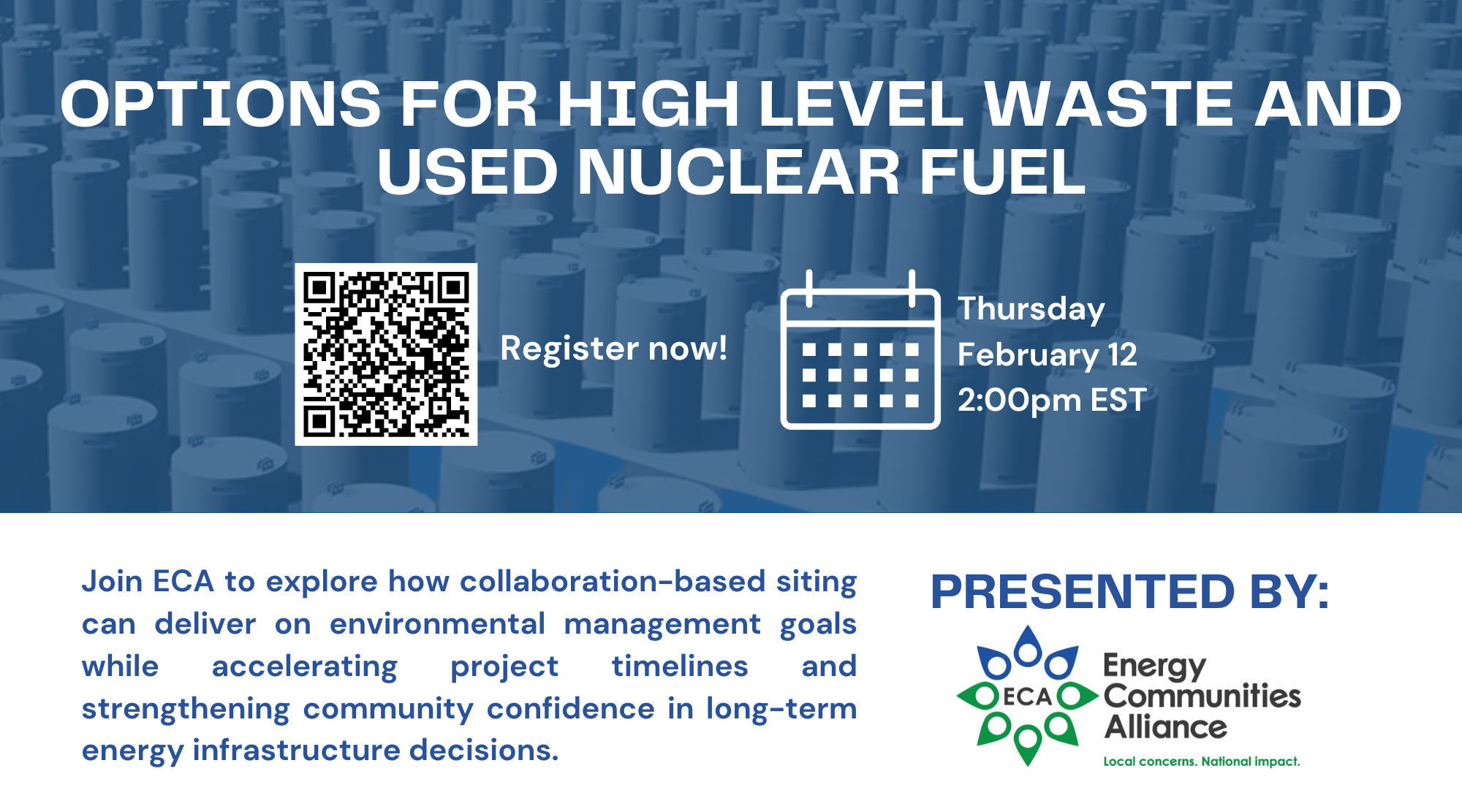
- Register today for ECA's next webinar, "Options for High Level Waste and Used Nuclear
Fuel" on February 12 at 2:00pm EST.
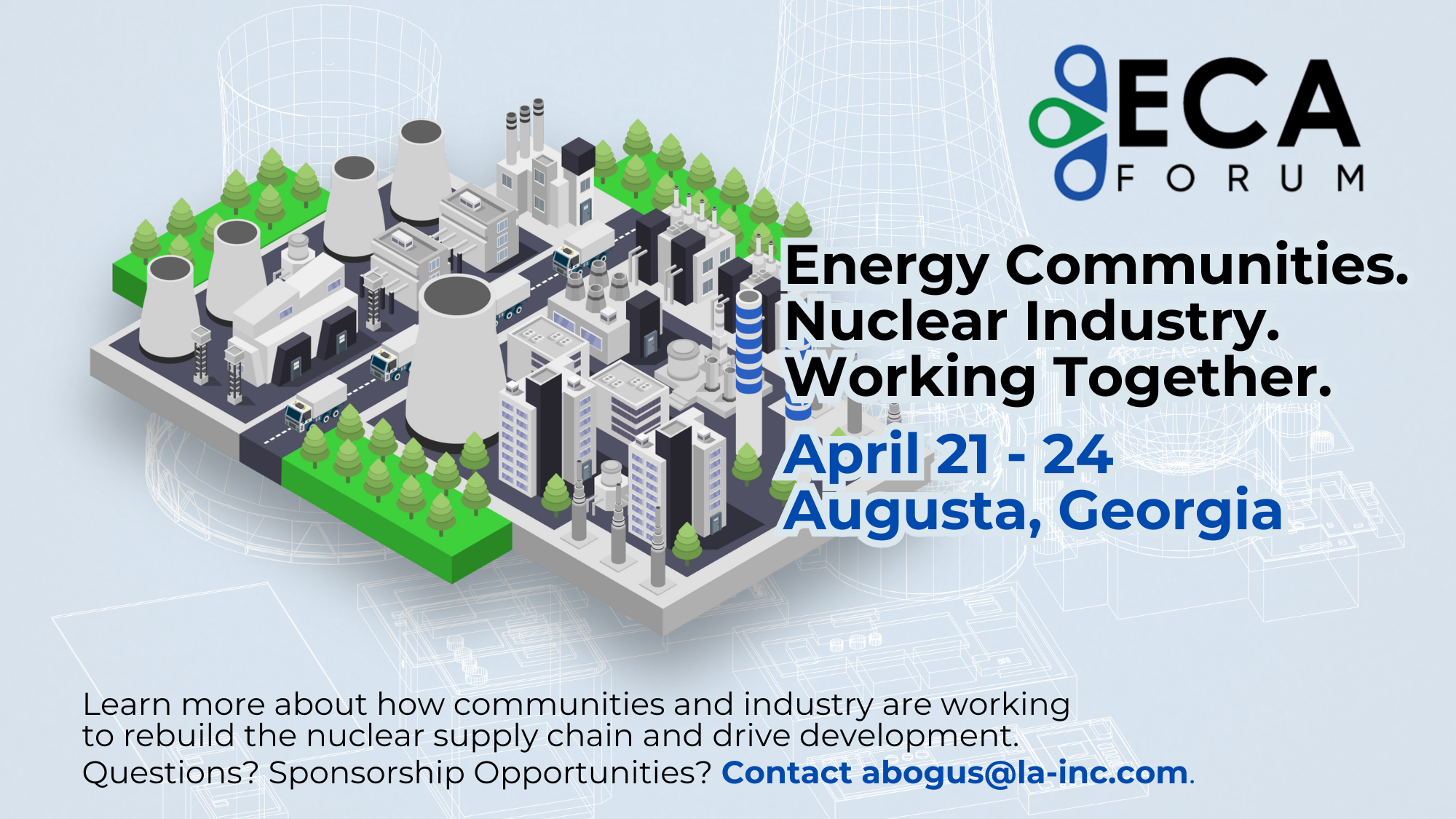
- ECA New Nuclear Forum
- 📅 Date: April 21-24
📍 Location: Augusta, GA 🔗 Register Here!
- Join us for insights, industry networking, and expert speakers from the people advancing new nuclear reactors across the United States. Whether you’re looking to begin learning about nuclear energy or
to deploy advanced reactors in your region, this is the place to be. Don’t miss out—secure your spot today!
- Visit ECA on LinkedIn for regular updates.
DOE CHANGES THE NEPA REVIEW PROCESS - WHAT ARE THE IMPACTS ON NUCLEAR PROJECTS AND THE HOST COMMUNITY?Accelerating nuclear projects has been a long-time mantra of Energy Communities Alliance and our communities. A key part of the acceleration has been the reliance by local governments on DOE, the Nuclear Regulatory Commission (NRC) and State regulators’ analysis and oversight, DOE and private industry engaging and involving local governments in decision-making, analysis of the impact of a project
(transportation, human health impacts, socioeconomic and environmental impacts and public safety), if any on the community, and the ability, where DOE or the private party does not want to engage with the local community, to promote transparency and provide municipalities and stakeholders with the opportunity to comment publicly and have the comments considered in the project. On February 2 (Monday), DOE issued a notice establishing a new National Environmental Policy Act (NEPA) categorical exclusion
(“CATEX”) for certain advanced nuclear reactor projects. The categorical exclusion applies to DOE actions related to the authorization, siting, construction, operation, reauthorization, and decommissioning of advanced reactors that meet specified safety and waste-management criteria – the whole fuel cycle for a reactor. In the past DOE could not issue a CATEX for these projects and typically undertook an Environmental Assessment or an Environmental Impact Statement which analyzes the impact of
the project and has a robust community engagement process. A CATEX does not have the same level of study or engagement. According to DOE, the CATEX is intended to apply to advanced reactor projects such as microreactors, SMRs, and Gen III+ and Gen IV designs, including DOE-authorized demonstration, testing, pilot, and deployment projects, where design features, fuel type, and fission product inventory
limit the potential for offsite environmental impacts. DOE identifies that DOD, NRC and DOE have learned a lot and the technologies have evolved and the full analysis and study is not needed and only increases the time of the projects. Energy Communities Alliance, as noted above wants to see projects move forward and we are analyzing DOE’s notice and the new option for DOE to use a CATEX. We ask ECA members
and others to send us the pros and cons of the CATEX and ECA will provide comments to DOE on the issues. We also hope to speak with DOE about how this will move projects forward quicker with the same level of safety and local government input and engagement. DOE’s key language for issuing a CATEX is now: Authorization,
siting, construction, operation, reauthorization, and decommissioning of advanced nuclear reactors, provided DOE determines that: (1) the project's attributes, including potential fission product inventory, fuel type, reactor design, and operational plans, reduce sufficiently the risk of adverse offsite consequences from the release of radioactive or hazardous materials, and (2) the project demonstrates that any hazardous waste, radioactive waste, or spent nuclear fuel generated by the project can be managed in accordance with applicable requirements. For the purposes of this category, a project may include multiple reactors within a nuclear facility. DOE's full
written record to explain the basis for the new categorical exclusion, including a discussion of relevant NEPA reviews, is available at https://www.energy.gov/nepa/articles/notice-new-categorical-exclusion-advanced-nuclear-reactors-february-2026 In summary, advanced nuclear reactors have key attributes such as safety features, fuel type, and fission product inventory that limit adverse consequences from releases of radioactive or hazardous material from construction, operation, and decommissioning. Although past advanced reactor projects
have been for solely experimental, testing and demonstration purposes, the advanced fuel forms, inherently safe designs, and inventories of potential fission products associated with these reactors indicate that reactors in this category developed for additional purposes, such as power production and industrial applications, are also appropriate for this categorical exclusion. Advanced reactor projects in this
category typically employ inherent safety features and passive safety systems, in addition to well-established fuel, coolant, and structural materials that support their associated DOE safety design basis. Performance of these fuels, systems, and materials is sufficient to provide reasonable assurance of adequate protection to the public, workers, and environment. New reactor designs and their associated fuels ensure containment of radionuclides in the event of an accident. Operational periods
for these projects will be bounded by the potential fission product inventory and will vary depending on the design and fuel type. Previously completed NEPA reviews have established that advanced reactors, including construction, operation, and decommissioning, characterized by technologies and materials (1) that have been verified to prevent adverse offsite consequences from release of radioactive or hazardous materials and (2) demonstrate that any hazardous waste, radioactive waste, or spent
nuclear fuel generated by the project can be managed in accordance with applicable requirements do not significantly affect the quality of the human environment. DOE is adding the new categorical exclusion for advanced nuclear reactors to its NEPA implementing procedures published outside the Code of Federal Regulations. DOE previously received public comments requesting that DOE add a categorical exclusion for
nuclear power reactors ( e.g.,84 FR 34074). DOE has elected voluntarily to solicit comments on its new categorical exclusion for advanced nuclear
reactors. DOE is soliciting comment on this new categorical exclusion and the associated written record, and may make revisions to this categorical exclusion, if DOE's review of any comments submitted suggests that further revisions are warranted. Commenters have 30 days from the date of publication of this notice to submit comments. Read the full notice here.
U.S.-RUSSIAN ARMS CONTROL TREATY EXPIRES THIS WEEKThe expiration this week of a core U.S.-Russia arms control treaty could touch off a global nuclear weapons race for the first time since the Cold War, POLITICO reports. Russia made initial overtures about a renewed pact in September, but the Trump administration has not formally responded, according to two people familiar with the negotiations. The New START treaty, which will expire on Thursday, was struck in 2010 and limited how many deployed nuclear-capable missiles, bombers and warheads both the U.S. and Russia could have. The likely dissolution of the agreement comes at an especially fraught time. Russia and China are expanding their strategic arsenals and the Kremlin has threatened to use nuclear weapons on Ukraine. The Defense Department has held a series of internal meetings in preparation for a post-New START world, according to the two people and another person familiar — all of whom were granted anonymity to discuss internal talks — although it’s not clear what
was discussed in the meetings. “We’re looking at a very uncertain path ahead,” said Daryl Kimball, the executive director of the Arms Control Association. “Unless Trump and Putin reach some sort of understanding soon, it’s not unlikely that Russia and the U.S. will start to upload more warheads on their missiles.” Russia, over the past decade, has
significantly expanded its intermediate-range nuclear-capable forces — such as the Oreshnik, a ballistic missile that it has used in combat with Ukraine. China has more than doubled the size of its nuclear arsenal as the U.S. scaled back on some nuclear-capable platforms. President Donald Trump has indicated that he would like a new deal, but said he wanted it to include China. Russian President Vladimir Putin’s offer from
September would have extended New START limits for another year, although it would have prevented inspections on weapons. Putin has also demanded that Britain and France participate in a follow-up treaty. Both countries can launch nuclear missiles from submarines or use fighter jets to drop atomic weapons, but do not have land-based intercontinental ballistic missiles in their arsenals. “Now is the time when some form of communication channels and transparency measures would be particularly valuable,” said Heather Williams, director of the Project on Nuclear Issues at the Center for Strategic and International Studies. “Russia suspended those sorts of activities and China has consistently rejected participation in arms control.” Read the full article here.
JOIN ECA FOR OUR NEXT WEBINAR "OPTIONS FOR HIGH LEVEL WASTE AND USED NUCLEAR FUEL"
The next installment of ECA's Winter Webinar Series continues February 12 at 2:00pm EST with "Options for High Level Waste and Used Nuclear Fuel". The siting of new nuclear facilities requires integrated nuclear waste solutions that balance technical, regulatory,
and social readiness. This goes beyond just regulatory compliance - it demands trust, transparency, and shared problem-solving among local governments, state agencies, developers, and residents. This webinar will explore how siting efforts can deliver on these environmental management goals while accelerating project timelines, developing local economies, and strengthening community confidence in long-term energy infrastructure decisions. Please contact AJ Ridge, ECA Program Director, with any questions at [email protected].
ECA NEW NUCLEAR FORUM TO BE HOSTED IN AUGUSTA, GA FROM APRIL 21-23, 2026
Energy Communities Alliance (ECA) is pleased to host the fifth annual ECA Forum in Augusta, GA from April 21 - April 23, 2026. The meeting is part of ECA’s ongoing New Nuclear Initiative to define the role of local governments in supporting the development of the new nuclear technologies. REGISTRATION RATES
General Attendees - register on or before Feb. 13 at a rate of $850.00. After Feb. 13, registration rates will increase
to $950.00.
Non-Profit & Government attendees - register on or before Feb. 13 at a rate of $695.00. After Feb. 13, registration rates will increase to $795.00. SCHEDULE: April
21 | Registration Opens & Nuclear 101
April 22 | Full-Day General Session
April 23 | Half-Day General Session
April 24 | All-Day Tour AGENDA:
To see the full Agenda, Click here!
Speakers to be announced soon! ECA is working with private and community partners to develop an agenda that takes a
comprehensive look at what new nuclear projects require - from the front-end to the back-end of the fuel cycle to aligning support at local, state and federal levels. The Forum will explore emerging options for enabling legislation, public-private partnerships and regulatory oversight. WHO SHOULD ATTEND?
The ECA Forum is open to communities, State, Tribal and local policymakers, industry, utilities,
developers, experts, financiers, state legislators, community groups, and economic development organizations working to build capacity and support for new nuclear development in the U.S.
WHAT YOU'VE MISSED: Oak Ridge at heart of US enrichment supply chain developments BWX Technologies and Centrus Energy have marked major milestones as they build up their centrifuge manufacturing capacity in Tennessee, with BWXT opening a new facility and Centrus announcing major expansion plans, while laser enrichment technology LIS Technologies is also investing in Oak Ridge. Read the full story Nuclear power research funding signed into law A federal appropriations package recently signed into law includes funding for two nuclear power research projects with connections to Southwest
Virginia. The Wise-based Energy DELTA Lab will receive about $1.4 million under the bill that became law last week, according to U.S. Rep. Morgan Griffith, R-Salem. “With this federal funding available to Energy DELTA Lab, Southwest Virginia community access to potential nuclear energy solutions will improve,” Griffith said in a recent news release. Read the full story Nuclear waste, state land use top Wyoming Legislature’s energy agenda
One of the most high-profile conflicts has centered on nuclear energy and whether the state should loosen its ban on spent nuclear fuel waste storage. House Joint Resolution 3, “Storage of spent nuclear fuel and waste-vote required,” aims to put the authority to decide directly in Wyoming voters’ hands. If passed, the general election ballot in November would include a referendum on whether to amend Wyoming’s constitution. Read the full story
Siting Options for High Level Waste and Used Nuclear Fuel - ECA Winter Webinar Series Virtual | February 12, 2026 Learn More Here Spent Fuel Storage and Advanced Fuel Cycle Facilities: Co-location for Safety and Sustainability - ECA Winter Webinar Series Virtual | March 5, 2026 Learn More Here ECA New
Nuclear Forum 2026 Augusta, GA | April 21 - 23 Learn More
Here National Cleanup Workshop 2026 Arlington, VA | September 14-16 Learn More Here
CATCH UP ON PAST WEBINARS Click the button below to visit ECA's YouTube Channel to rewatch past webinars, and
find the recordings from our most recent webinars below!
ECA Winter Series: Co-location Options with Nuclear Storage January 8,
2026 As data centers and advanced fuel cycle facilities seek reliable, carbon-free power, new opportunities are emerging to co-locate these energy-intensive operations with nuclear generation and spent fuel storage sites. Such integration could strengthen grid resilience, reduce transmission losses, align high-demand digital infrastructure with established nuclear security and safety protocols and diversify
economic opportunities for host communities and regions. Yet it also raises complex questions about regulatory frameworks, community acceptance, and long-term stewardship of nuclear materials. This webinar will bring together experts from the energy, technology, and policy sectors to explore how thoughtful colocation strategies can balance innovation, safety, and public trust in the next generation of nuclear infrastructure.
Speakers will include:
Moderator - Jennifer
Chandler - Council Member, Village of Piketon
Randall Hemann - City Manager, City of Oak Ridge
David Pointer - Director, Nuclear Energy and Fuel Cycle Division, ORNL
Michele Sampson - Director, Division of New and Renewed Licenses, Office of Nuclear Reactor Regulation, NRC
Dr. Jenifer Shafer- Associate Director
for Technology and Program Director, ARPA-E View the full webinar recording here! ECA Winter Series: Advancing New Nuclear with Datacenter Development December 8, 2025 As artificial intelligence and cloud computing drive exponential growth in electricity demand, data center developers are turning to nuclear energy for reliable, carbon-free power needed to operate continuously. This session explores the concerns local officials must address when co-locating data centers with existing or new nuclear generation. Speakers will discuss
regulatory considerations, what makes an “ideal” site, community engagement, and partnership models that align digital infrastructure expansion with public safety and sustainability goals. Moderator: AJ Ridge - Director of Programs, ECA Iain Macdonald - Principal and Future Energy Systems Development Lead, HKS Ilissa Miller - Editor-in-Chief, DataCenter Post David Reeploeg - Executive Director, Hanford Communities Peter Rodrik - Associate Administrator for Partnership and Acquisition Services, NNSA Aditi Verma - Assistant Professor, University of Michigan View the full webinar recording here! ECA Winter Series: Creating Emergency Response
Planning for Nuclear Storage Projects November 6, 2025 Advanced nuclear projects are moving toward construction, and local governments play a frontline role in ensuring that emergency preparedness and management systems keep pace with development. City and county officials oversee first responders, coordinate public safety
communications, and maintain the trust of residents who live and work near project sites. This webinar will highlight how mayors, emergency managers, and developers collaborate to build readiness from day one—through joint planning, drills, and transparent communication. Participants will gain insight into best practices for integrating project-specific safety requirements into local emergency operations and for sustaining preparedness over the full lifecycle of a nuclear facility. Speakers include: Moderator: Laura Hermann - Deputy Executive Director, Energy Communities Alliance Chief Mike Cochran - Police Chief, City of Craig, Colorado Lea
Perlas - Fusion Program Director, Virginia Department of Health Randall Ryti - Councilor, Los Alamos County, New Mexico Brian Scroggins - Administrator of the Division of Planning, Nevada Agency for Nuclear Projects View the full webinar recording here! ECA Summer Series: Investing in Innovation: Financing Advanced Nuclear Projects September 12, 2025 Wall Street has arrived to Main Street. Understanding financing pathways is no longer optional—it’s a prerequisite for informed local leadership and successful project development. Join ECA in
its upcoming webinar featuring panelists shaping financing solutions for new generation of nuclear projects. Learn about the new business models emerging and how the financing will occur. Nuclear projects will only move forward if they are financeable. While government funding has played a vital role, the new generation of projects are looking at how to structure the “capital stack” and use a mix of private financing (debt and equity), tax credits, and DOE loan program. In addition, the
announced Power Purchase Agreements between utilities and large off-taker such as Google, Meta and Amazon are providing the credit needed to attract financing – once the projects are ready for market. Join a conversation that will bring together government and the private sector to discuss these items and make recommendations on how these projects can move forward to facilitate these exciting business opportunities. This means real opportunities to attract capital, create jobs, and leverage
nuclear projects for broader economic development. Speakers include experts shaping the future of nuclear finance: Facilitator: Seth Kirshenberg - Executive Director | Energy Communities Alliance and Partner, Kutak Rock LLP Andy Roehr - Managing
Director | Baker Tilly Advisory Group, LP Anthony Huston - Managing Partner | Quadrant Nuclear Industries Chris Lohse - Innovation and Technology Manager | Gateway for Accelerated Innovation in Nuclear View the full webinar recording here!
|
|