TODAY'S HIGHLIGHTS & WHAT TO KNOW THIS WEEK
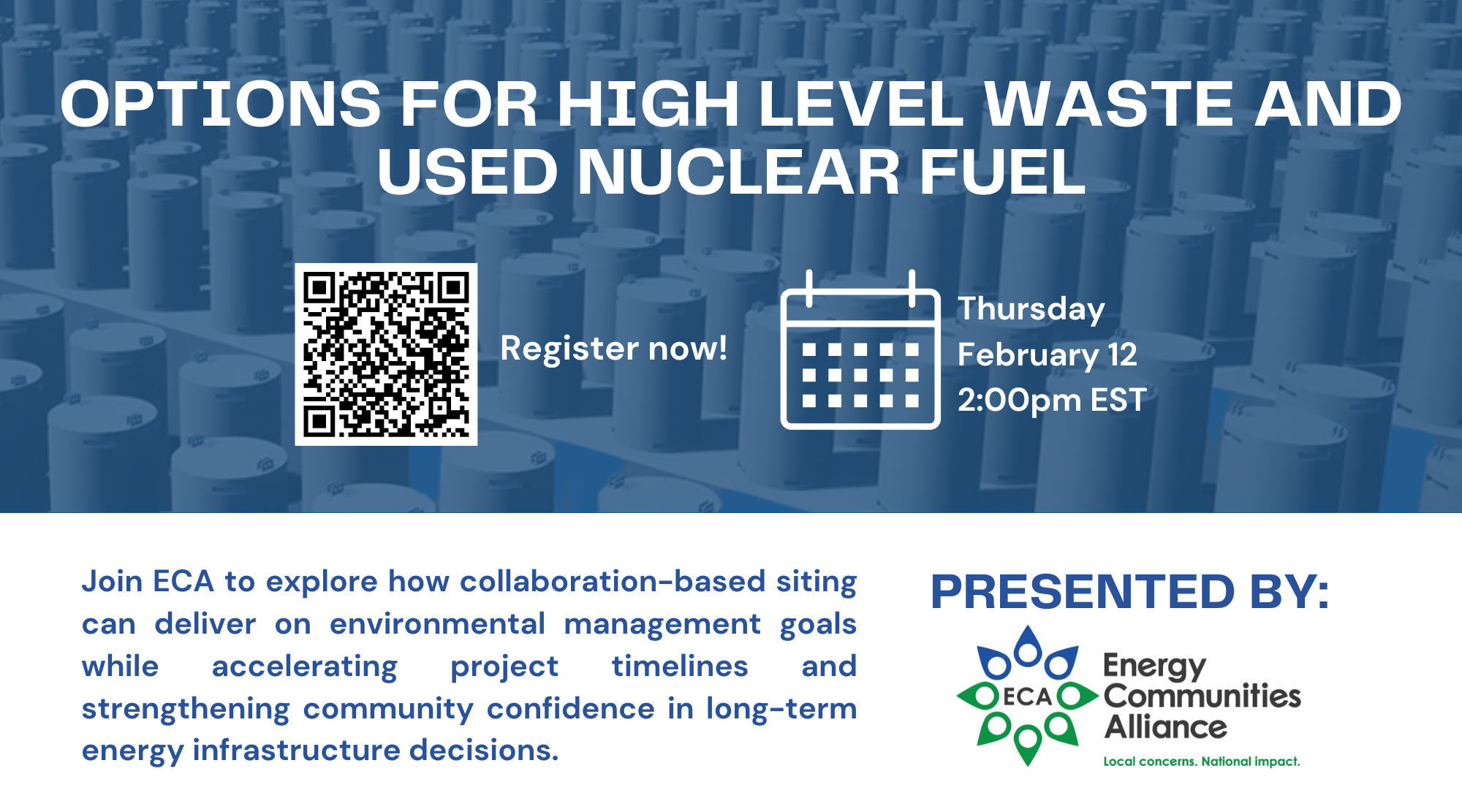
- Join us Thursday for ECA's next webinar, "Siting Options for High Level Waste and Used Nuclear Fuel" on February 12 at 2:00pm EST.
- DOE-EM announces its restart of uranium recovery operations at the Savannah River Site H Canyon facility in South Carolina
- read more below.
- Forthcoming bipartisan legislation poised to act as a backstop on nuclear reactor development - read more below
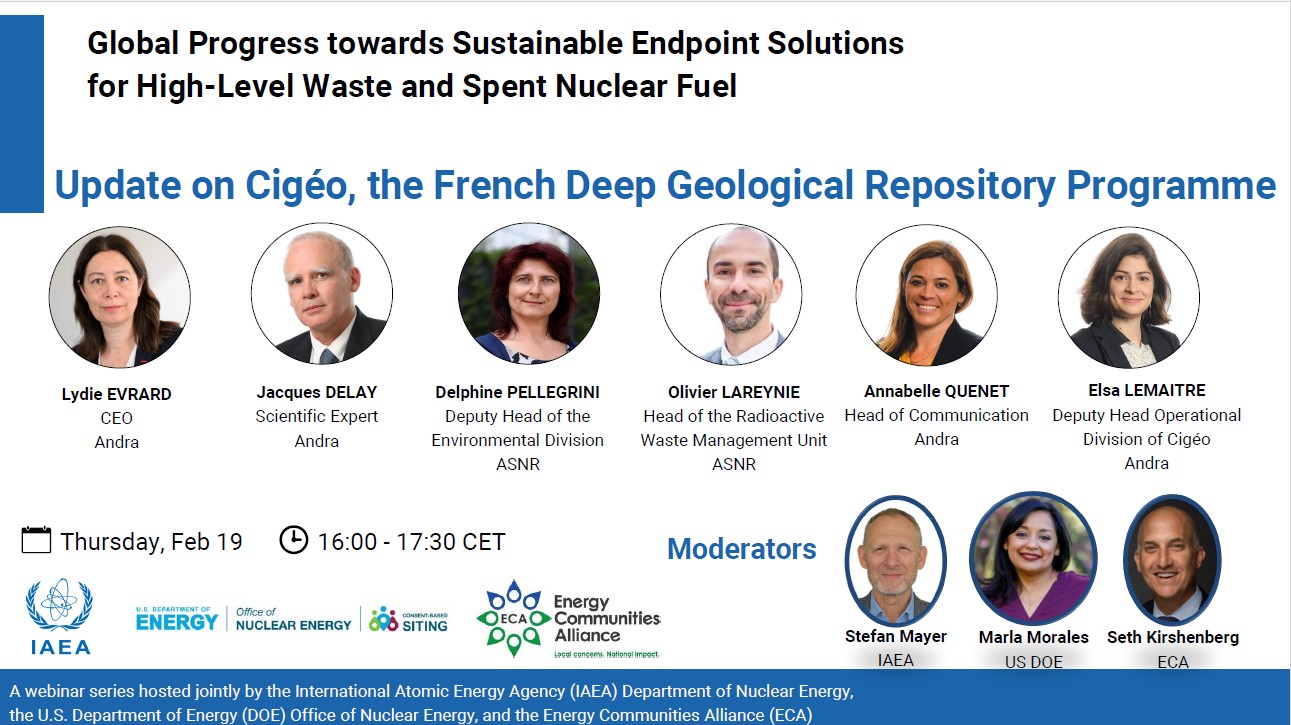
- Join IAEA, DOE-NE, and ECA on upcoming webinar "Update on Cigéo, the French Deep Geological Repository Programme" on
February 19 at 10:00am EST.
- Upcoming Environmental Management Site-Specific Advisory Board, Oak Ridge meeting to happen on March 11 from 6:00 - 8:00 pm EST.
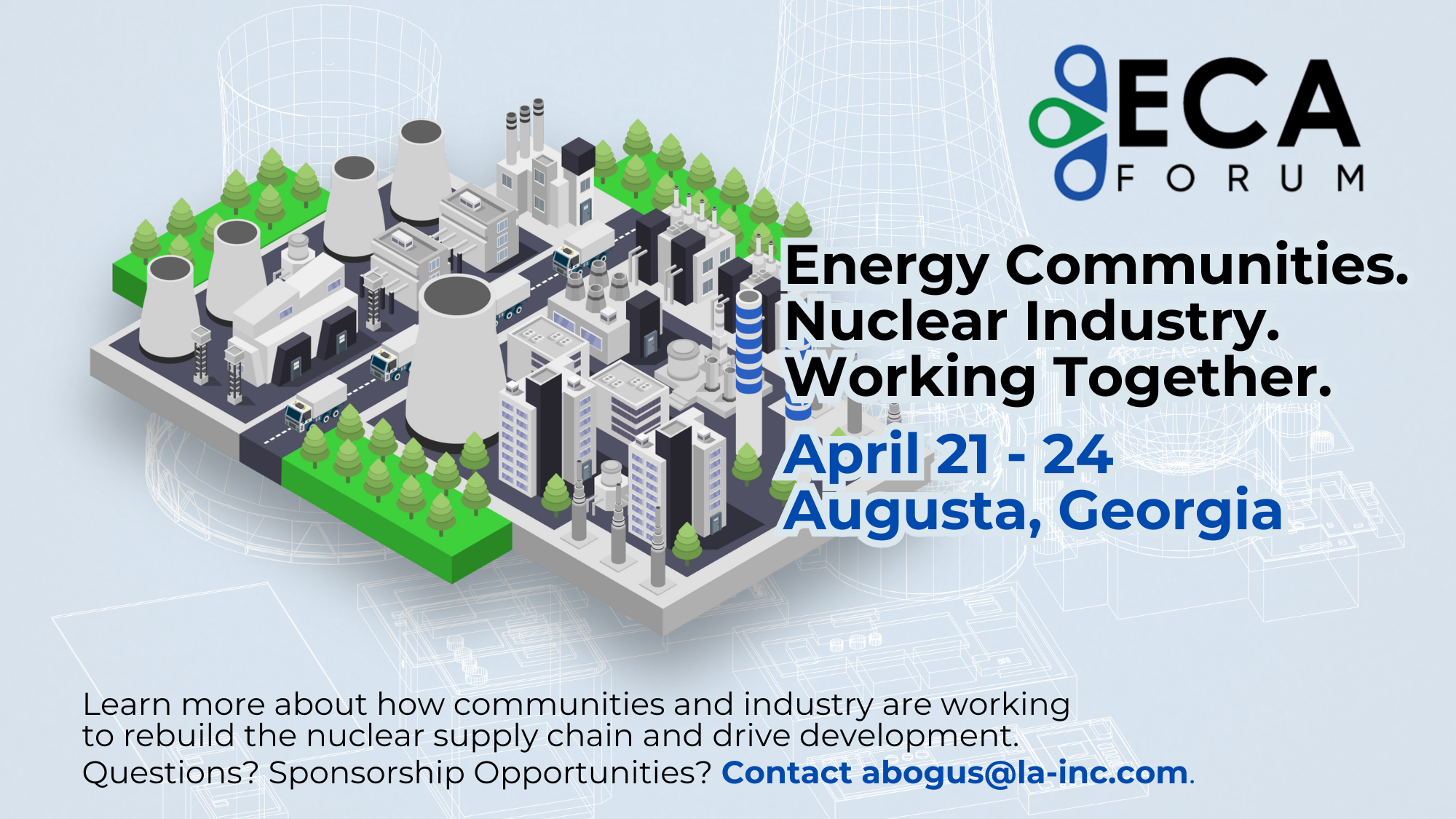
- ECA New Nuclear Forum
- Don't wait - Early Bird Registration ends this
week!
- 📅 Date: April 21-24
📍 Location: Augusta, GA 🔗 Register Here!
- Join us for insights, industry networking, and expert speakers from the people advancing new nuclear reactors across the United States. Whether you’re looking to begin learning about nuclear energy or
to deploy advanced reactors in your region, this is the place to be. Don’t miss out—secure your spot today!
- Visit ECA on LinkedIn for regular updates.
JOIN ECA FOR OUR NEXT WEBINAR "SITING OPTIONS FOR HIGH LEVEL WASTE AND USED NUCLEAR FUEL"
The next installment of ECA's Winter Webinar Series continues February 12 at 2:00pm EST with "Siting Options for High Level Waste and Used Nuclear Fuel". The siting of new nuclear facilities requires integrated nuclear waste solutions that balance technical,
regulatory, and social readiness. This goes beyond just regulatory compliance - it demands trust, transparency, and shared problem-solving among local governments, state agencies, developers, and residents. This webinar will explore how siting efforts can deliver on these environmental management goals while accelerating project timelines, developing local economies, and strengthening community confidence in long-term energy infrastructure decisions. Speakers will include: Facilitator: Laura Hermann - Deputy Executive Director, ECA Matt Bowen - Research Scholar, Center on Global Energy Policy Kara Colton - Director
of Nuclear Policy, ECA David Reeploeg - Vice President of Federal Programs, TRIDEC Jack Volpato - Eddy-Lea Energy Alliance Please contact AJ Ridge, ECA Program Director, with any questions at [email protected].
DOE-EM ANNOUNCED ITS RESTART OF URANIUM RECOVERY OPERATIONS AT SAVANNAH RIVER SITE H CANYONDOE-EM announced last week that it is restarting uranium recovery operations at the H Canyon facility, located at the Savannah River Site in South Carolina. The decision to restart uranium recovery will produce high-assay low-enriched uranium (HALEU)
needed for advanced reactors, as well as recovering valuable isotopes currently available in limited domestic quantities, supporting critical needs in scientific research, medical applications and commercial uses. In addition, the facility will continue to safely process used nuclear fuel as part of SRS's cleanup mission. HALEU - uranium enriched to contain between 5% and 20% uranium-235 - will be used to fuel many advanced
reactors. The current inventory of used nuclear fuel at SRS contains enough highly enriched uranium to produce as many as 19 metric tons of HALEU, enough to fuel several proposed small modular reactors. "Thanks to President Trump's leadership, we're maximising the value of existing assets, supporting national security objectives and advancing our cleanup mission - all while supplying America's next generation of advanced
nuclear reactors," EM Assistant Secretary Tim Walsh said. Meanwhile, DOE EM has signed a lease with General Matter, unlocking the potential of the Fuels and Materials Examination Facility (FMEF) at the Hanford site to be used for advanced nuclear fuel cycle technologies and materials. "This partnership holds great promise for rebuilding the domestic
nuclear fuel supply chain and unlocking nuclear energy critical for meeting growing demand for affordable, reliable baseload power needed to fuel the artificial intelligence (AI) race," DOE EM said. Hanford was the site of US military plutonium production activities from 1943 until 1987, with nine nuclear reactors and associated processing facilities. The DOE's Richland Operations Office now manages the site and is
responsible for the clean-up of all its remaining waste streams. The FMEF was constructed in the Cold War to support the Liquid Fast Breeder Reactor Program. Spanning 190,000 square feet, the FMEF was never used in any nuclear capacity. Although fully constructed and equipped, the facility never supported an operational nuclear mission and has remained dormant for three decades. Alongside the DOE, General Matter will undertake the evaluations necessary to assess returning the facility to service, including site characterisation, potential facility upgrades and engagement with community leaders and stakeholders. "Activating FMEF for a modern mission reflects responsible stewardship and forward momentum for the site," said Ray Geimer, manager for Hanford Field
Office. "This lease puts an asset back to work for the American people and reinforces the Department's commitment to safe revitalisation across the Hanford footprint." "Rebuilding America's nuclear fuel capabilities is critical to strengthening our nuclear industrial base, reducing our reliance on foreign providers and lowering energy costs for utilities and consumers," added General Matter CEO Scott Nolan. "We thank our
partners in Hanford and the Department of Energy for supporting us in the development of a stronger, more secure nuclear fuel supply chain built here in the United States." General Matter said the FMEF lease builds on its ongoing development of a new enrichment facility at the former Paducah Gaseous Diffusion Plant in Kentucky. General Matter was one
of four companies selected in October 2024 by the DOE to provide enrichment services to help establish a US supply of HALEU. The company did not emerge from stealth until April 2025, and in August signed a lease with the DOE for the reuse of federal land at the former Paducah Gaseous Diffusion Plant in Kentucky for a new commercial uranium enrichment facility. Read the full article here.
BIPARTISAN DUO TO INTRODUCE FEDERAL BACKSTOP FOR NUCLEAR REACTORSSen. Jim Risch is seeking to revive legislation that would provide billions of dollars in federal backing for over-budget nuclear reactors, and this time, he has a prominent Democrat as a partner, POLITICO reports. The Idaho Republican, the chair of the Senate Foreign Relations Committee, plans to introduce
the “Accelerating Reliable Capacity (ARC) Act of 2026” on Tuesday alongside Sen. Ruben Gallego (D-Ariz.), a leading nuclear energy advocate. The bill, which resembles and shares the name of legislation Risch introduced in 2024, would authorize up to $3.6 billion to help offset cost overruns at three or more next-generation nuclear reactor projects. “The U.S. must remain the undisputed global leader when it comes to nuclear energy,” Risch said. “To do so, we need advanced reactors that can meet growing energy demand here at home and that we can deliver to customers around the world.” He added: “The ARC Act will ensure continued U.S. leadership in nuclear energy by incentivizing best practices and mitigating the financial risks needed to get new reactors
online." Nuclear power has increasingly become an area of bipartisan agreement on Capitol Hill, as Democrats have embraced the energy source for its emissions benefits. The most recent major legislation on nuclear that made into law was the ADVANCE Act, a bill that sought to jump-start a new generation of nuclear reactors by streamlining federal regulations. The idea of a federal backstop, however, scratches a different legislative itch long asked for by nuclear developers and industry advocates. Traditional and next-generation nuclear designs —including smaller, factory-built reactors meant to reduce construction costs — have faced significant budget overruns and schedule delays. Those challenges have spooked utilities, analysts say, stalling widespread commercial deployment. To address that, the bill would create a new Accelerating Reliable Capacity Program Account inside the Department of Energy’s Loan
Programs Office, now publicly rebranded as the Office of Energy Dominance Financing. Under the program, developers would remain responsible for the first 20 percent of any cost overruns beyond a vetted construction estimate. After that threshold is exceeded, the federal government would split additional overruns evenly with the developer, up to a maximum federal contribution of $1.2 billion per project. “With essential financing solutions and consumer protections, this legislation can accelerate the commercialization of advanced nuclear technology, enhance U.S. energy independence, and strengthen our global leadership in clean and reliable energy innovation,” said Maria Korsnick, president and CEO of the Nuclear Energy Institute. Federal funding would only
be disbursed after a project is completed and placed into service, a design meant to prevent developers from collecting subsidies without finishing construction. The bill also mandates robust project oversight, including executive-level progress reviews, quarterly project team meetings involving DOE and congressional staff and rigorous verification of construction schedules, labor forecasts and cost estimates. Those safeguards may prove particularly important this time. The 2026 version of the bill authorizes $3.6 billion in direct congressional appropriations, whereas the 2024 iteration relied on existing funding streams from the Inflation Reduction Act and bipartisan infrastructure law. “Getting new nuclear projects off the ground is a financial risk many
companies simply can’t take,” Gallego said. “I’m proud to introduce this bipartisan legislation with Senator Risch to reduce that risk and accelerate investment in advanced nuclear.” Gallego has positioned himself as one of Congress’s most vocal nuclear proponents. In December, he released an energy framework that placed advanced nuclear at the center of his strategy to lower power prices over the next decade. Energy Secretary Chris Wright may also be inclined to back the bill. He has used the Office of Energy Dominance Financing primarily to support the reopening of shuttered reactors such as Three Mile Island, and has signaled openness to broader nuclear support. “We’ll arrange creative incentives to build nuclear reactors in our space,” Wright said at a Senate
hearing last year. “We do need to make sure funding is available in the Loan Programs Office, because — used judiciously — it’s a way to leverage private capital and make things happen fast.” Read the full article here.
UPCOMING IAEA WEBINAR: UPDATE ON CIGÉO, THE FRENCH DEEP GEOLOGICAL REPOSITORY PROGRAMME
Coming up on February 19, from 10:00 am to 11:30 am EST, the International Atomic Energy Agency (IAEA) Department of Nuclear Energy, the U.S. Department of Energy (DOE) Office of Nuclear Energy, and the Energy Communities Alliance (ECA) are co-hosting a webinar titled "Update on
Cigéo, the French Deep Geological Repository Programme".
REGULATORY ROUNDUPDepartment of Energy Environmental Management Site-Specific Advisory Board, Oak Ridge DOE announces an in-person/virtual meeting of the Environmental Management Site-Specific Advisory Board (EM SSAB), Oak Ridge. The meeting will take place on Wednesday, March 11, 2026; 6 – 8 p.m. EST at Department of Energy (DOE) Information Center, Office of Science and Technical Information, 1 Science.gov Way, Oak Ridge, Tennessee 37831. This meeting will be held in-person at the DOE Information Center and virtually. To receive the virtual access information, please send an
e-mail to: [email protected] at least two days prior to the meeting. Click here for more
information.
ECA NEW NUCLEAR FORUM TO BE HOSTED IN AUGUSTA, GA FROM APRIL 21-23, 2026
Energy Communities Alliance (ECA) is pleased to host the fifth annual ECA Forum in Augusta, GA from April 21 - April 23, 2026. The meeting is part of ECA’s ongoing New Nuclear Initiative to define the role of local governments in supporting the development of the new nuclear technologies. REGISTRATION RATES
General Attendees - register on or before Feb. 13 at a rate of $850.00. After Feb. 13, registration rates will increase
to $950.00.
Non-Profit & Government attendees - register on or before Feb. 13 at a rate of $695.00. After Feb. 13, registration rates will increase to $795.00. SCHEDULE: April
21 | Registration Opens & Nuclear 101
April 22 | Full-Day General Session
April 23 | Half-Day General Session
April 24 | All-Day Tour AGENDA:
To see the full Agenda, Click here!
Speakers to be announced soon! ECA is working with private and community partners to develop an agenda that takes a
comprehensive look at what new nuclear projects require - from the front-end to the back-end of the fuel cycle to aligning support at local, state and federal levels. The Forum will explore emerging options for enabling legislation, public-private partnerships and regulatory oversight. WHO SHOULD ATTEND?
The ECA Forum is open to communities, State, Tribal and local policymakers, industry, utilities,
developers, experts, financiers, state legislators, community groups, and economic development organizations working to build capacity and support for new nuclear development in the U.S. THANK YOU TO OUR SPONSORS Atkins DOE-NE GAIN
Siting Options for High Level Waste and Used Nuclear Fuel - ECA Winter Webinar Series Virtual | February 12, 2026 Learn More Here Spent Fuel Storage and Advanced Fuel Cycle Facilities: Co-location for Safety and Sustainability - ECA Winter Webinar Series Virtual | March 5, 2026 Learn More Here ECA New
Nuclear Forum 2026 Augusta, GA | April 21 - 23 Learn More
Here National Cleanup Workshop 2026 Arlington, VA | September 14-16 Learn More Here
CATCH UP ON PAST WEBINARS Click the button below to visit ECA's YouTube Channel to rewatch past webinars, and
find the recordings from our most recent webinars below!
ECA Winter Series: Co-location Options with Nuclear Storage January 8,
2026 As data centers and advanced fuel cycle facilities seek reliable, carbon-free power, new opportunities are emerging to co-locate these energy-intensive operations with nuclear generation and spent fuel storage sites. Such integration could strengthen grid resilience, reduce transmission losses, align high-demand digital infrastructure with established nuclear security and safety protocols and diversify
economic opportunities for host communities and regions. Yet it also raises complex questions about regulatory frameworks, community acceptance, and long-term stewardship of nuclear materials. This webinar will bring together experts from the energy, technology, and policy sectors to explore how thoughtful colocation strategies can balance innovation, safety, and public trust in the next generation of nuclear infrastructure.
Speakers will include:
Moderator - Jennifer
Chandler - Council Member, Village of Piketon
Randall Hemann - City Manager, City of Oak Ridge
David Pointer - Director, Nuclear Energy and Fuel Cycle Division, ORNL
Michele Sampson - Director, Division of New and Renewed Licenses, Office of Nuclear Reactor Regulation, NRC
Dr. Jenifer Shafer- Associate Director
for Technology and Program Director, ARPA-E View the full webinar recording here! ECA Winter Series: Advancing New Nuclear with Datacenter Development December 8, 2025 As artificial intelligence and cloud computing drive exponential growth in electricity demand, data center developers are turning to nuclear energy for reliable, carbon-free power needed to operate continuously. This session explores the concerns local officials must address when co-locating data centers with existing or new nuclear generation. Speakers will discuss
regulatory considerations, what makes an “ideal” site, community engagement, and partnership models that align digital infrastructure expansion with public safety and sustainability goals. Moderator: AJ Ridge - Director of Programs, ECA Iain Macdonald - Principal and Future Energy Systems Development Lead, HKS Ilissa Miller - Editor-in-Chief, DataCenter Post David Reeploeg - Executive Director, Hanford Communities Peter Rodrik - Associate Administrator for Partnership and Acquisition Services, NNSA Aditi Verma - Assistant Professor, University of Michigan View the full webinar recording here! ECA Winter Series: Creating Emergency Response
Planning for Nuclear Storage Projects November 6, 2025 Advanced nuclear projects are moving toward construction, and local governments play a frontline role in ensuring that emergency preparedness and management systems keep pace with development. City and county officials oversee first responders, coordinate public safety
communications, and maintain the trust of residents who live and work near project sites. This webinar will highlight how mayors, emergency managers, and developers collaborate to build readiness from day one—through joint planning, drills, and transparent communication. Participants will gain insight into best practices for integrating project-specific safety requirements into local emergency operations and for sustaining preparedness over the full lifecycle of a nuclear facility. Speakers include: Moderator: Laura Hermann - Deputy Executive Director, Energy Communities Alliance Chief Mike Cochran - Police Chief, City of Craig, Colorado Lea
Perlas - Fusion Program Director, Virginia Department of Health Randall Ryti - Councilor, Los Alamos County, New Mexico Brian Scroggins - Administrator of the Division of Planning, Nevada Agency for Nuclear Projects View the full webinar recording here! ECA Summer Series: Investing in Innovation: Financing Advanced Nuclear Projects September 12, 2025 Wall Street has arrived to Main Street. Understanding financing pathways is no longer optional—it’s a prerequisite for informed local leadership and successful project development. Join ECA in
its upcoming webinar featuring panelists shaping financing solutions for new generation of nuclear projects. Learn about the new business models emerging and how the financing will occur. Nuclear projects will only move forward if they are financeable. While government funding has played a vital role, the new generation of projects are looking at how to structure the “capital stack” and use a mix of private financing (debt and equity), tax credits, and DOE loan program. In addition, the
announced Power Purchase Agreements between utilities and large off-taker such as Google, Meta and Amazon are providing the credit needed to attract financing – once the projects are ready for market. Join a conversation that will bring together government and the private sector to discuss these items and make recommendations on how these projects can move forward to facilitate these exciting business opportunities. This means real opportunities to attract capital, create jobs, and leverage
nuclear projects for broader economic development. Speakers include experts shaping the future of nuclear finance: Facilitator: Seth Kirshenberg - Executive Director | Energy Communities Alliance and Partner, Kutak Rock LLP Andy Roehr - Managing
Director | Baker Tilly Advisory Group, LP Anthony Huston - Managing Partner | Quadrant Nuclear Industries Chris Lohse - Innovation and Technology Manager | Gateway for Accelerated Innovation in Nuclear View the full webinar recording here!
|
|