TODAY'S HIGHLIGHTS & WHAT TO KNOW THIS WEEK
- American Nuclear Society responds to study on nuclear plant proximity - read more below.
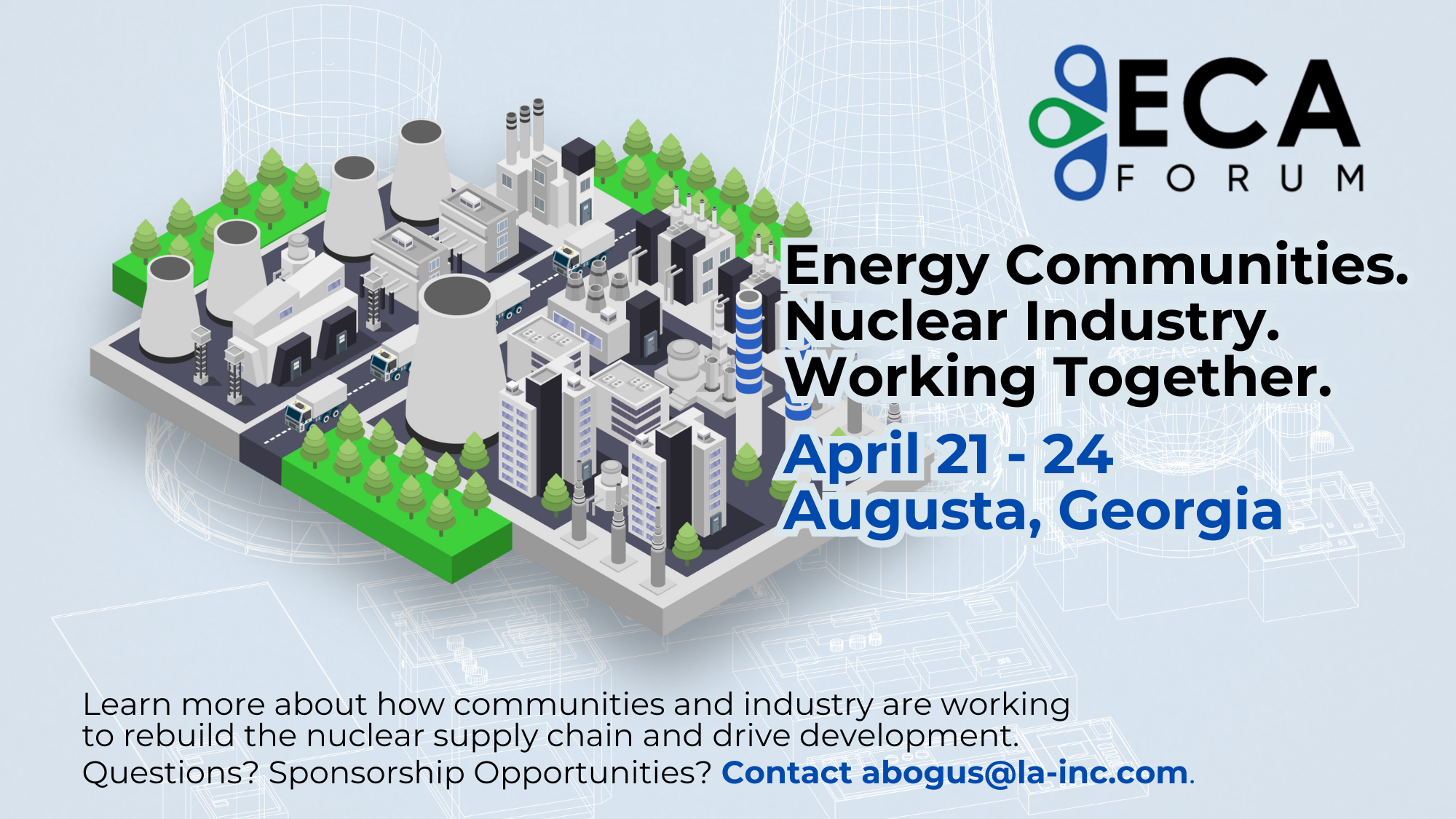
- ECA New Nuclear Forum
- 📅 Date: April 21-24
📍 Location: Augusta, GA 🔗 Register Here!
- Thank you to our top tiered sponsors Atkins Realis and Oklo!
- DOE Assistant Secretary Walsh has confirmed his attendance to discuss the future of reusing DOE sites for nuclear and data center development.
- NNSA Associate Principal Deputy Administrator James McConnell has confirmed his
attendance to discuss how the federal government is directing nuclear initiatives and what advancements these initiatives will achieve.
- Join us for insights, industry networking, and expert speakers from the people advancing new nuclear reactors across the United States. Whether you’re looking to begin learning about nuclear energy or to deploy advanced reactors in your region, this is the place to be. Don’t miss out—secure your spot today!
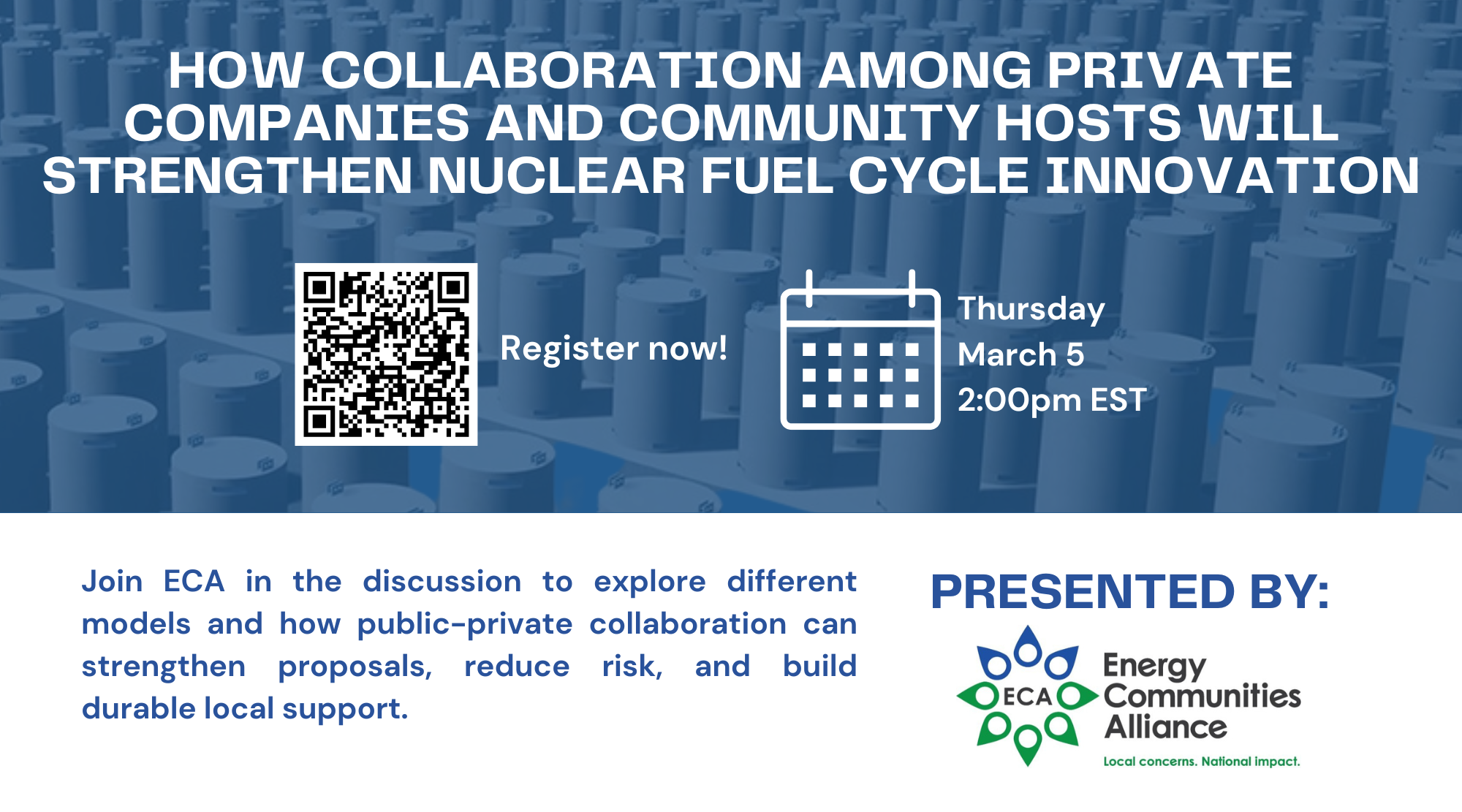
- Join ECA on
March 5 from 2:00 - 3:00pm EST for the final installment of our Winter Webinar Series, How Collaboration Among Private Companies and Community Hosts Will Strengthen Nuclear Fuel Cycle Innovation. - click here to
register!
- Visit ECA on LinkedIn for regular updates.
DON'T MISS OUT! NEW SPEAKERS ANNOUNCED FOR NEW NUCLEAR FORUM
Energy Communities Alliance (ECA) is pleased to host the fifth annual ECA Forum in Augusta, GA from April 21 - April 23, 2026. The meeting is part of ECA’s ongoing New Nuclear Initiative to define the role of local governments in supporting the development of the new nuclear technologies. ECA is excited to announce James McConnell, Associate
Principal Deputy Administrator at the National Nuclear Security Administration will be speaking at the forum.
THANK YOU TO OUR SPONSORS We would like to give a big thanks to Gold Sponsor Atkins Realis for their support of
energy communities and making this must-attend event a reality. Atkins Realis are stewards of CANDU® technology, a Canadian pressurized heavy-water reactor design, which has been used to generate electric power for more than 60 years. For almost 30 years, Atkins has successfully addressed some of the industry’s most challenging cleanup and decommissioning tasks across various facilities. They offer an array of
specialized nuclear safety, quality assurance, oversight and assessment services, supported by a team of experienced personnel dedicated to serving our customers. Meet Atkins Realis and a whole host of other nuclear leaders, developers, and innovators at the ECA Forum!
REGISTRATION RATES
General Attendees - $950.00.
Non-Profit & Government attendees - $795.00. SCHEDULE: April 21 | Registration Opens & Nuclear 101
April 22 | Full-Day General Session
April 23 | Half-Day General Session
April 24 | All-Day Tour AGENDA:
To see the full Agenda, Click here!
Additional speakers to be announced soon! ECA is working with private and community partners to develop an agenda that takes a
comprehensive look at what new nuclear projects require - from the front-end to the back-end of the fuel cycle to aligning support at local, state and federal levels. The Forum will explore emerging options for enabling legislation, public-private partnerships and regulatory oversight. WHO SHOULD ATTEND?
The ECA Forum is open to communities, State, Tribal and local policymakers, industry, utilities,
developers, experts, financiers, state legislators, community groups, and economic development organizations working to build capacity and support for new nuclear development in the U.S. THANK YOU TO OUR SPONSORS
AMERICAN NUCLEAR SOCIETY RESPONDS TO STUDY ON NUCLEAR PLANT PROXIMITY
The American Nuclear Society (ANS), a nonprofit representing over 12,000 professionals in the fields of nuclear science and technology, issues the following response to "National Analysis of Cancer Mortality and Proximity to Nuclear Power Plants in the United States," by Yazan Alwadi, Petros Koutrakis, et al., published February 23, 2026, in Nature Communications. Experts with ANS, including health physicists and radiation protection specialists, have reviewed the study published in Nature Communications purporting to show associations between residential
proximity to nuclear power plants and elevated cancer mortality rates across U.S. counties from 2000 to 2018. This study contains fundamental methodological shortcomings, acknowledged by the authors themselves, that prevent it from supporting any credible scientific conclusions. "This flawed ecological study does not advance our understanding of radiological risk. The authors themselves state that their findings "cannot
establish causality" and that their study "does not include dosimetry," admissions that undermine the study's central premise and that ANS urges journalists and policymakers to weigh carefully" the ANS stated in a press release on Thursday. ANS lays out their core scientific issues with the publication below: 1. The Authors' Own
Admissions The paper explicitly acknowledges that its findings "cannot establish causality," that it "does not include dosimetry," and that its attributable deaths calculation "assumes a causal relationship between exposure and outcome," an assumption the study's own design cannot validate. These are not peripheral disclaimers; they go to the heart of whether this study can support the conclusions being drawn from
it. 2. No Dose Assessment The study includes no dosimetric measurements, environmental radiation monitoring data, dose modeling, or exposure pathway analysis. Even a basic calculation using publicly available plant emission data would demonstrate that radiation doses received by populations near U.S. nuclear plants are far too low to plausibly
account for the cancer mortality burden the authors describe, making the absence of this foundational step disqualifying. 3. Proximity as an Invalid Proxy for Radiation Dose The study's sole exposure measure, an inverse-distance weighted proximity metric, is not a measure of radiation exposure and does not account for plant-specific emission
profiles, wind patterns, topography, or water pathways. Using geographic proximity as a radiation dose proxy introduces severe exposure misclassification and cannot support the conclusions the study implies. 4. A Critical and Unaddressed Confounding Factor: Load-Serving Entity Territories Nuclear power plants were deliberately sited near major
population and industrial load centers, the high-demand service territories of load-serving entities where heavy manufacturing, fossil fuel combustion, and associated carcinogenic pollutants are most concentrated. No county-level statistical model can fully untangle those exposures from any signal attributed to a nuclear facility, representing a profound and unresolved confounding problem. 5. Ecological Study Design
Cannot Support Causal Claims This is an ecological study, widely recognized as the weakest epidemiological study design for establishing causation, and is appropriate only for generating hypotheses, not for estimating attributable deaths. Presenting county-level correlations as the basis for calculating over 115,000 "attributable cancer deaths" dramatically overstates what this study design can support. 6. Inadequate Confounding Control While the authors include several county-level covariates, ecological analyses inherently cannot account for the full range of cancer risk factors present in the heavily industrialized, densely populated regions where nuclear plants are typically located. Smoking, occupational exposures, fossil fuel emissions, and
socioeconomic factors, among others, remain inadequately controlled. 7. All-Cancer Outcomes Without Radiation Sensitivity Context The study analyzes all malignant neoplasms combined rather than the radiation-sensitive cancers, such as leukemia and thyroid cancer, for which dose-response relationships are established. A credible study of this
kind would demonstrate a biologically plausible dose-response relationship; this study does not. The Broader Scientific Context: Decades of rigorous research by the National Cancer Institute, the U.S. Nuclear Regulatory Commission, and international scientific bodies including the United Nations Scientific Committee on the Effects of
Atomic Radiation have not found consistent evidence of elevated cancer risk near nuclear plants operating within regulatory limits. That is the science. This study does not change that nor add to it. ANS concludes that this study does not meet the highest scientific standards, a fact the authors themselves explicitly acknowledge with the admission that “our findings cannot establish causality.” The absence of dose
assessment, a fatally limited study design, unresolved industrial confounding, and the unwarranted attribution of over 115,000 cancer deaths to geographic correlation represent serious and compounding failures. ANS stands ready to assist reporters and stakeholders in contextualizing this research within the broader, well-established body of radiological health science. Read the full article here.
UPCOMING ECA WEBINAR: HOW COLLABORATION AMONG PRIVATE COMPANIES AND COMMUNITY HOSTS WILL STRENGTHEN NUCLEAR FUEL CYCLE INNOVATION
Join ECA on March 5 from 2:00 - 3:00pm EST for the final installment of our Winter Webinar Series, How Collaboration Among Private Companies and Community Hosts Will Strengthen Nuclear Fuel Cycle Innovation. DOE’s recent Request for Information on Nuclear Fuel Cycle Innovation Campuses signals federal interest in accelerating advanced fuel capabilities — potentially including HALEU production, fuel fabrication, recycling, testing infrastructure, and integrated research hubs. Today’s discussion focuses on the central question: How will collaboration among private companies and community leaders strengthen the delivery of Nuclear Fuel Cycle Innovation Campuses? Join
the discussion to explore different models and how public-private collaboration can strengthen proposals, reduce risk, and build durable local support. Speakers will include: John Pfeffer - Supervisor, Town of Ashford Bill Goodwin - Chief Legal & Strategy Officer, Oklo Rod Baltzer - CEO, Deep Isolation Curtis Roberts II - VP of Communications and Press Officer, Orano USA Please contact AJ Ridge, ECA Program Director, with any questions at [email protected].
HANFORD TOPPLES MANHATTAN PROJECT-ERA EXHAUST STACK
The U.S. Department of Energy’s (DOE) Hanford Site and contractor Central Plateau Cleanup
Company (CPCCo) are advancing the Hanford mission with safe and successful demolition of the 175-foot-tall K West Reactor exhaust stack. This achievement represents another step towards cocooning the last of nine Hanford reactors to be placed in safe, long-term storage. “This project demonstrates how we are using careful planning and expert technology to expedite legacy cleanup actions,” said Hanford Site Manager Ray
Geimer. “Safely removing this structure is an important step in clearing the area around the K reactor for the next phase of demolition where heavy equipment will access and demolish the old K West fuel storage basin that is connected to the K West reactor building. In doing so, we are clearing the path for the final stages of decommissioning the K West Reactor, which supports an overarching strategy to expedite decommissioning, reduce long-term surveillance and maintenance requirements, and
eliminate threats to the environment.” “Our team is focused on execution and mission completion,” said CPCCo President Bob Wilkinson. “Successfully bringing down this structure allows us to accelerate the timeline for cocooning K West, demonstrating our commitment to being responsible stewards of the land and continuing our drive to reduce sitewide risk.” With the stack removed, crews can finalize the enclosure of the
reactor core, effectively “shrinking” the area requiring active oversight along the Columbia River. By removing these aging structures, Hanford continues to transition from its Manhattan Project and Cold War legacy toward a safe and prosperous future. Read the full press release here.
NRC PROPOSES NEW REGULATIONS ON FUSION WASTE
On Thursday, the NRC proposed new regulations giving it regulatory responsibility to manage
waste from fusion nuclear power generators. The new proposed rule comes as the Trump administration is doubling down on its nuclear energy efforts. The rule would follow through on a requirement the 2019 Nuclear Energy Innovation and Modernization Act laid out that the NRC
create regulations to support the development of fusion machines and fission reactors. “The proposed rule would add new requirements and modify some existing requirements to license and oversee the possession, use, and production of byproduct material associated with fusion machines,” the notice reads. The NRC is calling the change a “limited-scope
rulemaking” involving definition changes with a focus on “fusion machines for both commercial and research and development purposes that are currently contemplated for deployment in the near term.” Read the full article from POLITICO here.
Spent Fuel Storage and Advanced Fuel Cycle Facilities: Co-location for Safety and Sustainability - ECA Winter Webinar Series Virtual | March 5, 2026 Learn More Here ECA New Nuclear Forum 2026 Augusta, GA | April 21 - 23 Learn More Here National Cleanup Workshop 2026 Arlington, VA | September 14-16 Learn More Here
CATCH UP ON PAST WEBINARS Click the button below to visit ECA's YouTube Channel to rewatch past webinars, and
find the recordings from our most recent webinars below!
ECA Winter Series: Options for High Level Waste and Used Nuclear Fuel February
12, 2026 The siting of new nuclear facilities requires integrated nuclear waste solutions that balance technical, regulatory, and social readiness. This goes beyond just regulatory compliance - it demands trust, transparency, and shared problem-solving among local governments, state agencies, developers, and residents. This webinar will explore how siting efforts can deliver on these environmental management goals
while accelerating project timelines, developing local economies, and strengthening community confidence in long-term energy infrastructure decisions. Speakers include: Facilitator: Laura Hermann - Deputy Executive Director, ECA Matt
Bowen - Research Scholar, Center on Global Energy Policy Kara Colton - Director of Nuclear Policy, ECA David Reeploeg - Vice President of Federal Programs, TRIDEC Jack Volpato - Eddy-Lea Energy
Alliance View the full webinar recording here! ECA Winter Series: Co-location Options with Nuclear Storage January 8,
2026 As data centers and advanced fuel cycle facilities seek reliable, carbon-free power, new opportunities are emerging to co-locate these energy-intensive operations with nuclear generation and spent fuel storage sites. Such integration could strengthen grid resilience, reduce transmission losses, align high-demand digital infrastructure with established nuclear security and safety protocols and diversify
economic opportunities for host communities and regions. Yet it also raises complex questions about regulatory frameworks, community acceptance, and long-term stewardship of nuclear materials. This webinar will bring together experts from the energy, technology, and policy sectors to explore how thoughtful colocation strategies can balance innovation, safety, and public trust in the next generation of nuclear infrastructure.
Speakers include:
Moderator - Jennifer
Chandler - Council Member, Village of Piketon
Randall Hemann - City Manager, City of Oak Ridge
David Pointer - Director, Nuclear Energy and Fuel Cycle Division, ORNL
Michele Sampson - Director, Division of New and Renewed Licenses, Office of Nuclear Reactor Regulation, NRC
Dr. Jenifer Shafer- Associate Director
for Technology and Program Director, ARPA-E View the full webinar recording here! ECA Winter Series: Advancing New Nuclear with Datacenter Development December 8, 2025 As artificial intelligence and cloud computing drive exponential growth in electricity demand, data center developers are turning to nuclear energy for reliable, carbon-free power needed to operate continuously. This session explores the concerns local officials must address when co-locating data centers with existing or new nuclear generation. Speakers will discuss
regulatory considerations, what makes an “ideal” site, community engagement, and partnership models that align digital infrastructure expansion with public safety and sustainability goals. Speakers include: Moderator: AJ Ridge - Director of Programs, ECA Iain Macdonald - Principal and Future Energy Systems Development Lead, HKS Ilissa Miller - Editor-in-Chief, DataCenter Post David Reeploeg - Executive Director, Hanford Communities Peter Rodrik - Associate
Administrator for Partnership and Acquisition Services, NNSA Aditi Verma - Assistant Professor, University of Michigan View the full webinar
recording here! ECA Winter Series: Creating Emergency Response Planning for Nuclear Storage Projects November 6, 2025 Advanced nuclear projects are moving toward construction, and local governments play a frontline role in ensuring that emergency preparedness and management systems keep pace with development.
City and county officials oversee first responders, coordinate public safety communications, and maintain the trust of residents who live and work near project sites. This webinar will highlight how mayors, emergency managers, and developers collaborate to build readiness from day one—through joint planning, drills, and transparent communication. Participants will gain insight into best practices for integrating project-specific safety requirements into local emergency operations and for
sustaining preparedness over the full lifecycle of a nuclear facility. Speakers include: Moderator: Laura Hermann - Deputy Executive Director, Energy Communities Alliance Chief Mike Cochran - Police Chief, City of Craig, Colorado Lea Perlas - Fusion Program Director, Virginia Department of Health Randall Ryti - Councilor, Los Alamos County, New Mexico Brian Scroggins - Administrator of the Division of Planning, Nevada Agency for Nuclear Projects View the full webinar recording here!
INL teams with Nvidia in Prometheus project to accelerate nuclear deployment Idaho National Laboratory and computer chip maker Nvidia have announced a public-private partnership to advance nuclear energy deployment through artificial intelligence. According to INL, the collaboration aims to cut reactor development times in half and reduce operational costs by 50 percent by using AI to design, license, manufacture, construct, and operate reactors with human-in-the-loop workflows. Read the full story ORNL, Kairos Power partner to advance deployment of next-gen nuclear energy
The Department of Energy’s Oak Ridge National Laboratory and Kairos Power have entered into a $27 million strategic partnership to accelerate the technology needed to deploy a new generation of advanced
nuclear reactors and support U.S. nuclear energy goals. Under the partnership, ORNL will provide expertise and access to specialized facilities to review and evaluate various aspects of Kairos Power’s novel fluoride salt-cooled high-temperature reactor design, which uses molten fluoride salt coolant with Tristructural ISOtropic (TRISO) fuel to generate reliable energy with robust inherent safety. Read the full story Bipartisan group of lawmakers reconsiders California's nuclear moratorium
Democrat Assemblymember Lisa Calderon introduced AB 2647 on February 20 to allow nuclear fission or fusion energy systems approved by the Nuclear Regulatory Commission since 2005 to be built despite the state’s moratorium. Republican Sen. Brian Jones is a coauthor of the new bill, along with Democrat Assembly members John Harabedian and Alex Lee. Read the full story
Gone Fission 2/9: It’s being called the biggest construction failure in American history. Companies went bankrupt. Executives went to jail. Ratepayers got stuck with the bill.
This week’s episode of the Gone Fission podcast takes a look at the history and current status of the
Virgil Summer Nuclear Plant in South Carolina. Can this vital project be successfully revived? Can it contribute to future energy needs? Our guest is Jim Little, an industry veteran and member of the SC Governor’s Nuclear Advisory Council. Virtual | February 12, 2026 Listen here!
|
|